How Limo Services Keep Luggage Safe and Secured During Transit
- Home
- How Limo Services Keep Luggage Safe and Secured During Transit


Dubai International handled 95.2 million passengers in 2025, and its baggage system mislaid roughly two bags in every thousand. The global average is 6.3. So as places to hand over a suitcase go, DXB is about as safe as they come.
Which leaves an awkward question for anyone arriving. If the airport almost never loses your bag, where does it go wrong?
Usually in the ninety or so metres between the carousel and the car. There is no conveyor on that stretch, no barcode, no accuracy rate. What there is instead is a crowded kerb, a driver you have not met, and a boot whose size nobody checked when the booking was made. White Line Limousine LLC has been moving passengers and their belongings around Dubai since 2011, and what follows is how a chauffeured service covers that gap, along with the things you can settle at the booking stage so it never becomes your problem.
Key takeaways Book to your bag count, not your head count. The two do not rise together across our fleet. One named chauffeur in one vehicle means your luggage never changes hands mid journey. Passports, laptops, medication and documents belong in the cabin, not the boot. The riskiest moments are all stationary: the arrivals kerb, the hotel forecourt, and the fourth stop of a long day. A private booking already records the vehicle and the driver, so a forgotten item stays traceable.
Terminal 3 runs a baggage system stretching roughly 175 kilometres. It moves a bag from check in to aircraft in an average of 29 minutes and clears up to 9.3 million bags a month at peak. More than 63 million bags went through DXB in 2025, at a reported accuracy of 99.8 percent.
No ground transport operation anywhere runs to those tolerances, and none needs to. But the figures do explain where luggage problems actually cluster. Almost nothing goes missing while a car is moving. Losses happen during handovers, and even a simple airport to hotel journey contains two of them.
Which makes it useful to think about chauffeured transport as a chain with very few links in it. Fewer handovers, each one accounted for, less to go wrong. Everything below follows from that idea.
Most luggage damage we hear about traces back to one thing, which is a vehicle that was never big enough for the load.
Cases that cannot go in the hold end up somewhere worse. Wedged between passengers. Stacked on a rear seat where they slide at the first junction. Leaning against a door that gets opened at the kerb. None of it looks dramatic at the time. It is still how suitcases get scratched, laptop screens get knocked, and something ends up on the pavement.
Our published capacities exist for this reason, and they repay a close read, because they do not behave the way most people assume.
| Vehicle | Passengers | Luggage |
|---|---|---|
| Lexus ES 300h | 3 | 3 |
| BMW 5 Series | 3 | 4 |
| Mercedes S Class | 3 | 3 |
| Toyota Highlander | 6 | 4 |
| Mercedes V250 | 6 | 5 |
| Citroen Spacetourer | 6 | 7 |
| GMC Yukon XL | 7 | 5 |
| Toyota Previa | 7 | 7 |
| 14 Seater High Roof | 14 | 10 |
| Mercedes Sprinter | 12 | 12 |
Look at the middle of that table. A Citroen Spacetourer seats six and takes seven bags. A GMC Yukon XL seats seven and takes five. For four people travelling with six large cases, the Yukon is the bigger vehicle and the Spacetourer is the correct one. A BMW 5 Series carries more luggage than several cars positioned well above it.
So we ask for a case count instead of working from headcount alone. An operator quoting on passengers is guessing, and that guess gets found out at the kerb with a queue building behind you. Figures for every vehicle we run are on the fleet page.
Here is the part that sounds minor until you have lost something. On a chauffeured booking your belongings never change hands.
You get one named chauffeur in one identified vehicle for the whole journey. Nothing transfers at a hub, nothing is reloaded between cars, and nobody unknown touches your bags. Book a full day and the same boot stays locked behind the same driver between stops, which beats ordering a fresh car at every location and loading four times into four strangers’ vehicles.
That continuity is also why we ask for the passenger’s name and mobile number when someone books on behalf of a guest. A chauffeur who can call the passenger directly will not hand a case to the wrong person in a hotel driveway where three guests are waiting for three different cars.
Watch a car being loaded properly and there is nothing much to see, which is how you know it is being done right.
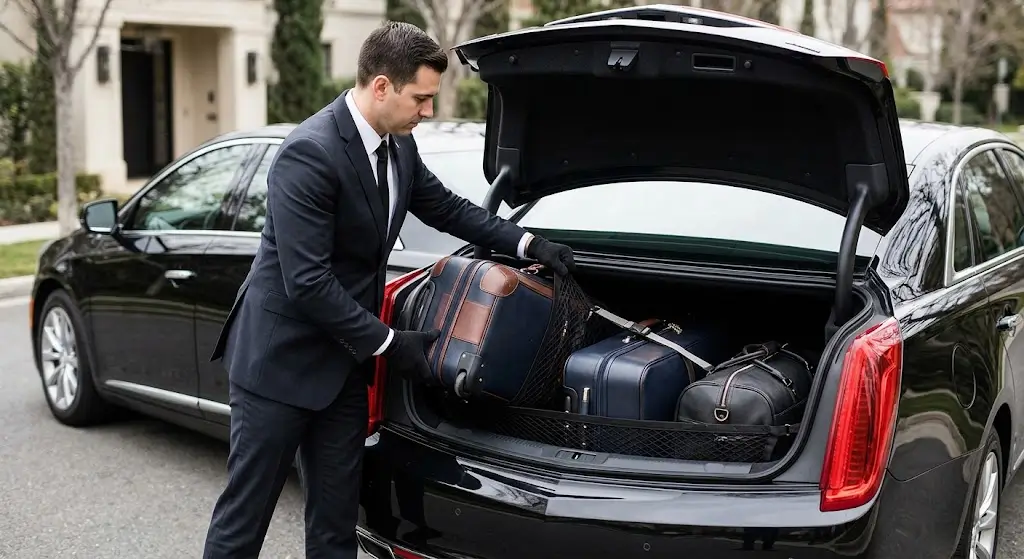
Heavy cases go in first and low so nothing shifts forward under braking. Anything fragile or with a screen sits on top. Bags with loose straps get positioned so the strap cannot catch on the boot lid as it closes. Golf clubs, camera equipment, musical instruments and pushchairs are placed, not posted, since those are the items a rushed loading damages first.
Whatever you will want during the drive stays in the cabin with you. Handbags, laptop bags, documents, medication and passports all belong within reach, not behind a closed boot on the Sheikh Zayed Road. The point lands hardest at the Oman border. We tell groups heading to Muscat to keep passports in the cabin, because unloading a full vehicle at a crossing to find one document takes longer than the crossing does.
Not one of them happens while the car is moving, which surprises people.
Start with the arrivals kerb at DXB. Loud, crowded, full of travellers wheeling identical black cases while traffic waits behind them. Picture two versions of the same pickup. In the first you find your car somewhere in a queue and load in a hurry. In the second the chauffeur meets you inside the terminal, takes the trolley and walks you out. Our airport meet and greet service exists for the second version, and it earns its keep for anyone landing with a family, a group, or more than two cases. We wrote about how those arrivals unfold in the first thirty minutes after landing.
Then the hotel forecourt. Bags come out, a porter appears, someone heads inside to check in, and for a minute or two nobody is really watching the luggage. Count your pieces as they leave the boot, while you are still standing there, because the forecourt is where a recount still fixes the problem. Our chauffeurs hand cases to the porter instead of setting them on a kerb and driving away.
Third comes the day with several stops in it. Four stops means four chances to leave something behind, and it is almost always the small bag that goes, never the suitcase. The fix costs nothing. At each stop, say out loud what is coming with you and what stays in the car. For group movements, our airport pickup and drop off planning guide for van rentals covers how to sequence a day so the stops stop piling up.
Everyone assumes a chauffeur handles the luggage, right up until they watch a driver sit tight while a guest wrestles a case into a boot.
Ours load and unload. They are RTA approved, speak English and Arabic, and reach the pickup point ahead of the booked time. That last detail is what makes careful loading possible at all, since a driver who arrives on the minute has already spent the two minutes the job needs. Vehicles are cleaned and inspected before each booking, so the boot taking your luggage is not still holding somebody else’s sand, water bottles or wedding decorations.
Our article on what a professional chauffeur notices about every passenger goes deeper into the observation habits behind this, and safety measures for rent a car with driver in Dubai sets out the wider standards we work to.
Some things are far easier to solve in advance than at the door on the morning.
Sports equipment changes the vehicle choice outright. A sedan that swallows four suitcases will not take two golf bags without a seat folding down, and skis and bicycles are a separate conversation again. Anything valuable or breakable belongs in the cabin where you can see it, which covers camera gear, artwork, instruments and laptops. Tell us when you book and the seating plan makes room for them instead of treating them as overflow once everything else is in.
Medical equipment and mobility aids need floor space and a set loading order. Cruise passengers work to a different rhythm entirely, since ship terminals move bags and people along separate paths, and our guide to coordinating limousine pickups at Port Rashid explains how those transfers are timed.
One more category deserves attention if your next step is a flight. Read the restricted list while you are packing, not while you are queuing at security. We keep a summary in Dubai airport prohibited items, and Dubai Airports publishes the official version.
Hardly anyone asks about this before they need to, which is a pity, because the answer separates one kind of booking from another more sharply than anything else on this page.
Think about what recovery looks like in each case. Leave something in a Dubai taxi and you report it to the Roads and Transport Authority, free of charge, on 8009090 or by email to ask@rta.ae. They will ask for the vehicle’s side number, the plate, the time and the destination, and you are advised to report within seven working days. The system works well. It also depends entirely on details most passengers never wrote down, since almost nobody photographs a taxi plate before getting in.
Leave something at the airport and the route splits again. Items lost in a terminal or on board an aircraft go through the Dubai Airports lost item form. Checked baggage is not theirs at all and goes to your airline.
A private chauffeur booking removes that whole step. The vehicle is ours, the driver is ours, and the booking record already names both before you get in the car. Contact us with the date, the pickup time and a description, and we can check the vehicle directly. No plate to remember, no seven day window counting down, which puts you somewhere quite different from a bag left in a car ordered through an app that has carried six passengers since.
Two habits stop any of it happening. Sweep the seat pocket and the footwell before you step out, because that is where phones and passports end up. Then count the pieces out loud as they leave the boot. Ten seconds of effort, and it does more for you than anything else written here.
Four details get you into the right vehicle. How many passengers, how many cases, anything oversized or fragile, and whether bags need to stay in the car between stops.
For a straightforward airport run, our airport transfer service is tracked against your flight number, so a delayed landing does not leave luggage sitting on a kerb. For a day of movements, a car with driver booking keeps the boot with you throughout.
Call +971 4 385 8433, WhatsApp +971 58 107 2614, or email booking@wllimo.com with your counts and we will confirm the vehicle that fits both.
How do limo services keep luggage safe during transit?
By using one chauffeur and one vehicle for the whole journey, loading heavy items low and first, keeping valuables in the cabin, and sizing the vehicle so cases travel in the hold instead of on seats. The chauffeur handles loading and unloading and hands over to hotel porters, so bags are never left unattended on a kerb.
How much luggage fits in a chauffeur driven car in Dubai?
It depends on the vehicle, and not in the order most people assume. In our fleet the Lexus ES 300h takes three bags, the BMW 5 Series four, the Mercedes V250 and GMC Yukon XL five each, the Citroen Spacetourer and Toyota Previa seven, and the Mercedes Sprinter twelve. Always give a case count alongside a passenger count, since seats and boot space do not rise together.
Which vehicle should I book for a family with six large suitcases?
Work from the bag count. Six large cases rules out every sedan and most seven seat SUVs in our fleet, which cap at five pieces. A Citroen Spacetourer or Toyota Previa at seven bags handles it comfortably, and a 14 seater high roof at ten pieces leaves margin if there is sports equipment or a pushchair as well.
Should valuables travel in the boot or the cabin?
The cabin. Laptops, cameras, documents, medication and passports should stay within reach, both for security and because getting them out of a closed boot mid journey is impractical. On a border run to Oman this applies to passports without exception.
What happens if I leave something in the limousine?
Contact us immediately with the date, pickup time and a description. Because a private chauffeur booking already records the vehicle and the driver, we can check the car directly. That differs from a street taxi, where the RTA process on 8009090 asks for the vehicle side number and plate and advises reporting within seven working days.
Do chauffeurs load and unload the luggage?
Yes. Handling luggage is part of a professional chauffeur’s role, alongside opening doors and waiting with the vehicle. Our chauffeurs also arrive ahead of the booked time, which is what allows loading to be done carefully instead of at speed while traffic builds behind the car.
How do I transport golf clubs or oversized equipment?
Mention them at the booking stage so the vehicle gets chosen around them. Oversized items change the answer completely, and a sedan that easily takes four suitcases may not take two golf bags without folding a seat.
Is luggage safer in a chauffeured car than in a taxi or ride hailing app?
The handling is more accountable, which is a different claim from the road being safer. A named chauffeur in a named vehicle across the whole journey means no reloading between cars, and a booking record identifying both means a forgotten item can be traced without the plate number you did not note down.
Does the chauffeur wait while we check in at the hotel?
Our chauffeurs hand cases to the hotel porter instead of leaving them on the kerb. If you need the vehicle held between stops, book it as a car with driver for the period instead of as separate transfers, which also keeps the boot with you throughout the day.
Need a Car with Driver in Dubai?
White Line Limousine — luxury cars with professional chauffeurs, from AED 400 per half day. Airport transfers, city tours and inter-Emirate travel across the UAE.
WhatsApp Us Now Call +971 55 432 3136