Car Airbags Guide: How It Works & More
- Home
- Car Airbags Guide: How It Works & More



One of the most essential safety features in a vehicle today is the car airbag. Airbags are intended to complement seatbelts during specific crash scenarios and help limit the chances of severe injury.
Today’s vehicles feature a variety of advanced airbag systems designed to protect occupants from different impact angles. These include front airbags in the steering wheel and dashboard, as well as side and curtain airbags positioned around the cabin.
If you regularly travel in luxury cars, understanding basic vehicle safety is just as important as choosing a reliable transportation https://www.wllimo.com/blog/car-airbags-guid…ow-it-works-more service. Passenger safety is a critical element of White Line Limousine’s chauffeur transportation service.
Whether you are travelling for work, attending an event, or making an airport transfer, understanding how your vehicle’s safety systems operate can provide additional peace of mind.
A car airbag is a supplemental restraint system designed to provide additional protection to occupants during certain types of accidents. It consists of an inflatable cushion, sensors, an electronic control unit, and an inflator mechanism.
An airbag is not designed to hold an occupant in place throughout the entire journey like a seat belt. Instead, it comes into play when the vehicle detects crash conditions that meet specific deployment criteria.
The airbag system rapidly inflates to create a barrier between the occupant and interior parts of the vehicle, including the steering wheel, dashboard, windows, or doors. It then deflates through specially designed openings to help absorb impact energy.
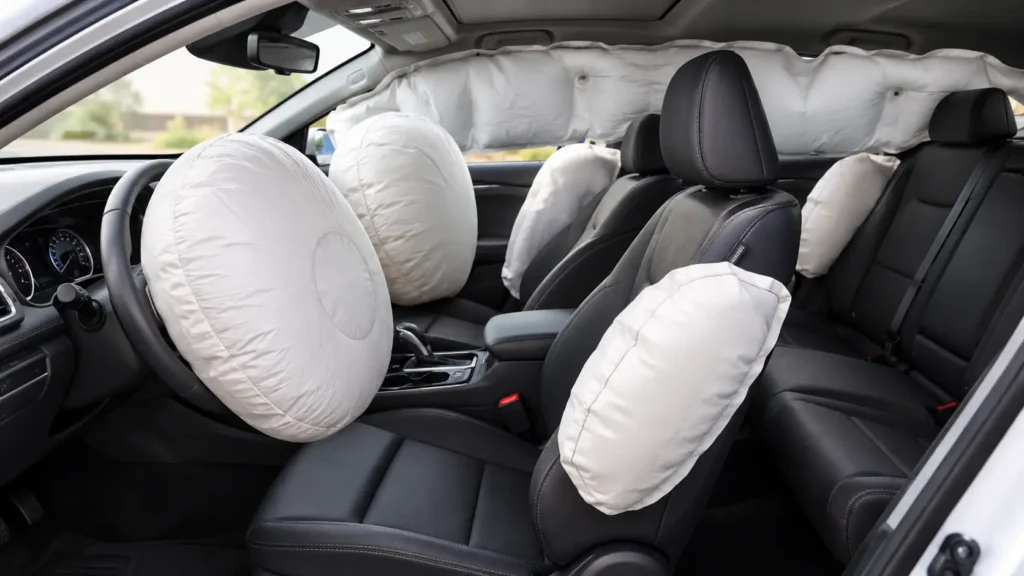
Airbags operate through a combination of sensors and electronic components. Crash sensors are positioned around the vehicle to monitor acceleration changes, movement, and impact forces.
During a collision, these sensors provide information to the vehicle’s airbag control module. The module evaluates the information and determines whether deployment is required.
When the system detects conditions that meet the deployment criteria, it activates an electrical signal to the appropriate inflator. The inflator generates gas that rapidly fills the airbag cushion.
This process happens extremely quickly. The airbag needs to inflate within the brief window between a qualifying collision and substantial occupant movement toward the interior of the vehicle.
After the initial impact, the airbag begins to deflate through vents in the cushion.
Modern vehicles can have several different types of airbags. Each type is positioned in a specific part of the cabin to provide additional protection during particular collision scenarios.
Front airbags are normally located in the driver’s steering wheel and in the dashboard in front of the passenger.
They are mainly designed to provide additional protection during certain frontal impacts.
Side airbags are often installed in vehicle seats or doors. They can provide additional protection during certain side-impact collisions.
When deployed, they create a protective layer between the occupant and the side structure of the vehicle.
Curtain airbags are generally located along the vehicle’s roofline.
When deployed, they expand downward alongside the windows. Depending on the vehicle’s configuration, they can help protect occupants during certain side-impact collisions and rollover situations.
Knee airbags are located beneath the dashboard in some vehicles.
These systems are designed to provide additional protection around the lower body and help manage occupant movement during particular collisions.
Some newer vehicles feature additional airbag systems designed for rear-seat passengers.
The configuration and design of these systems can vary depending on the vehicle manufacturer and model.
Airbags do not necessarily deploy in every accident.
Several factors can influence whether an airbag deploys, including the direction of the collision, collision force, changes in acceleration, sensor information, and vehicle design.
A minor impact may not meet the conditions required for deployment.
Similarly, during a collision from a particular direction, certain airbags may deploy while others remain inactive.
Visible vehicle damage does not necessarily mean that every airbag should have deployed. The airbag control system is designed to determine whether deployment is necessary for the specific crash conditions.
Airbags are also known as supplemental restraint systems because they are designed to work with seat belts rather than replace them.
A seat belt helps secure an occupant and limits excessive movement during a collision. An airbag provides additional cushioning during the impact.
The combination of both systems is therefore an important part of vehicle safety.
Even when a vehicle is equipped with multiple airbags, drivers and passengers should always wear their seat belts. Passengers should also remain properly seated and use the restraint system provided in a professional chauffeur vehicle.
Airbags are typically activated during crash conditions detected by the vehicle’s safety system. However, abnormal conditions or system faults can potentially affect the airbag system.
An SRS or airbag warning light that remains illuminated on the instrument panel may indicate a problem.
Potential causes can include faulty sensors, damaged wiring, electrical problems, or failures involving other SRS components.
Because the airbag is an important safety component, a warning light should not be ignored. The vehicle should be examined by a skilled automotive technician who can properly diagnose the system.
Airbags are typically one-time safety devices. After deployment, an airbag normally cannot simply be reset or folded back into its original location.
The deployed airbag generally needs to be replaced.
A collision may also affect other components of the restraint system. Depending on the circumstances, technicians may need to inspect the airbag control module, crash sensors, seat belts, seat-belt pretensioners, steering wheel, dashboard, seats, and related wiring.
Damage may not always be visible from the exterior of the vehicle. This is why professional inspection is important after a collision involving airbag deployment.
The airbag or SRS indicator is one of the most important safety indicators found on a vehicle’s dashboard.
If the warning light remains illuminated after the vehicle starts, it may indicate an issue with the restraint system.
The problem could involve a sensor, electrical connection, control module, wiring, or another component of the SRS system.
Even if the vehicle continues to drive normally while the warning light is illuminated, this does not necessarily mean that the safety system is functioning correctly.
Professional diagnosis can help identify the cause of the warning and determine whether repairs are required.
Airbags are designed to provide enhanced protection for vehicle occupants. However, they must inflate extremely quickly during a qualifying crash and therefore deploy with considerable force.
For this reason, it is important for occupants to sit correctly and use their seat belts.
Drivers should maintain an appropriate distance from the steering wheel, while passengers should remain properly seated and follow the vehicle manufacturer’s safety guidelines.
Children should use age- and size-appropriate child restraint systems in accordance with applicable safety guidance.
Airbags do not require replacement as frequently as other vehicle components such as engine oil or brake parts.
However, the system should be inspected if the SRS warning light comes on or if the vehicle has been involved in a major collision.
Do not modify airbags, wiring, seats, steering wheels, or other SRS-related equipment without professional advice. Incorrect modifications can interfere with the intended operation of the safety system.
Periodic professional inspections can also help identify potential warning signs before they develop into significant vehicle safety issues.
Vehicle safety is especially important when transporting passengers to and from their destinations.
Airport transfers, business trips, events, and long-distance journeys all require reliable vehicles and professional passenger transportation.
At White Line Limousine, passenger comfort is combined with attention to vehicle condition and safety measures. A professional chauffeur driver Dubai service should provide passengers with a well-maintained vehicle and a reliable transportation experience.
Passengers should consider important vehicle safety features, including airbags, seat belts, and other restraint systems, when choosing transportation in Dubai.
For customers searching for reliable chauffeur services Dubai, safety, comfort, vehicle condition, and professional service should all be important considerations.
A professional chauffeur service is not simply about getting from one location to another. It is also about providing passengers with a comfortable and dependable journey from pickup to drop-off.
Car airbags are complex safety devices that provide additional protection during certain types of accidents.
They use sensors, electronic control units, and rapidly inflating cushions to help protect occupants against different kinds of impacts.
However, airbags do not replace seat belts. Proper seating, seat-belt use, and attention to SRS warning indicators remain important parts of vehicle safety.
When an airbag has deployed or the SRS warning light has appeared, the vehicle should be professionally inspected and repaired before being used to transport passengers again.
For passengers choosing professional transportation, White Line Limousine offers chauffeur-driven travel focused on comfort, reliability, and a professional passenger experience.
From airport transfers and business trips to special occasions, having a well-maintained vehicle and professional chauffeur service can make every journey more comfortable and reassuring.
Need a Car with Driver in Dubai?
White Line Limousine — luxury cars with professional chauffeurs, from AED 400 per half day. Airport transfers, city tours and inter-Emirate travel across the UAE.
WhatsApp Us Now Call +971 55 432 3136