How Photographers and Content Creators Use Car with Driver Services for Location Shoots
- Home
- How Photographers and Content Creators Use Car with Driver Services for Location Shoots


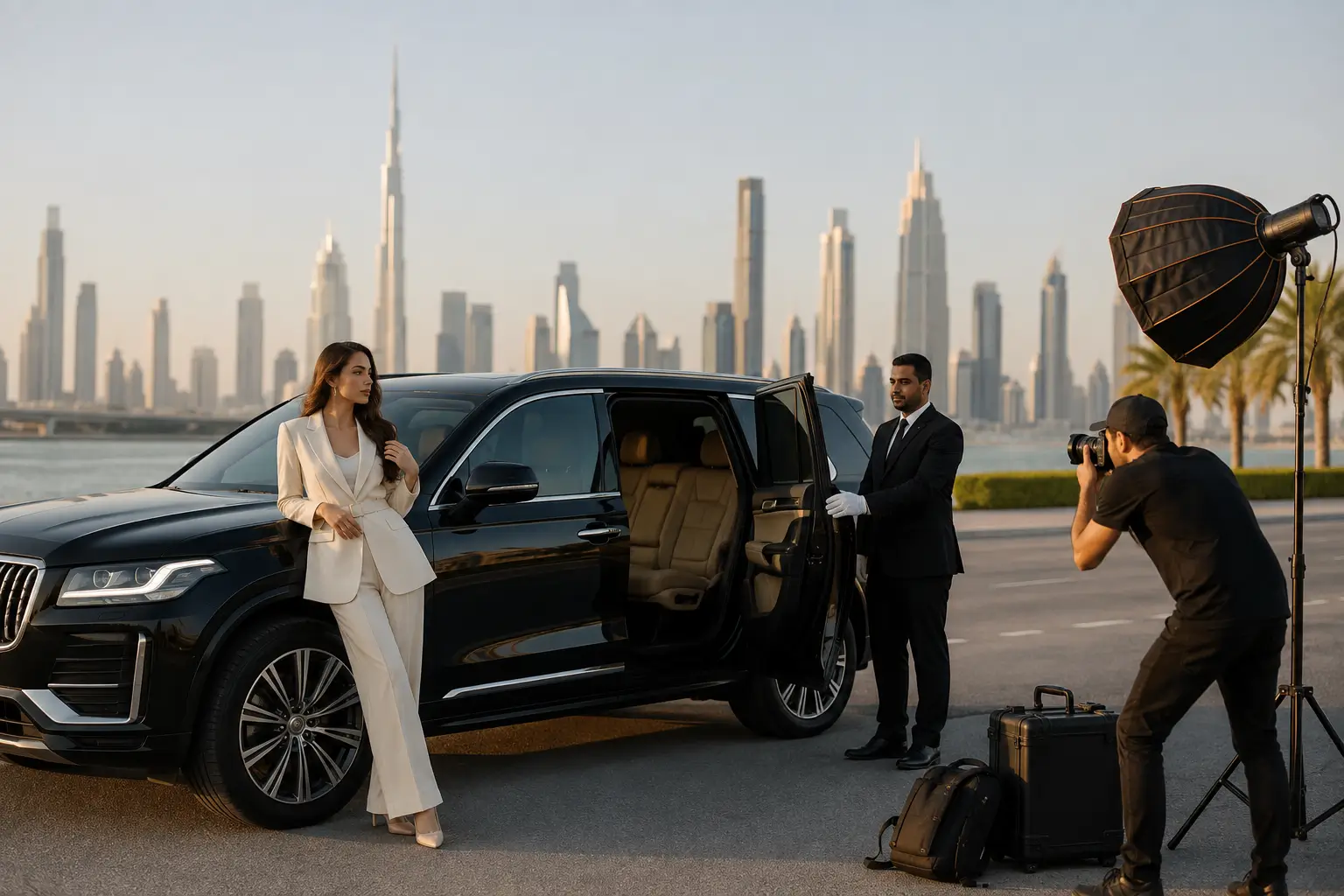
Logistics turn into a creative challenge when they are a location shoot in Dubai. The photographer/content creator is shown five frames, two of which are golden hour, followed by a wardrobe change between the two stops, and the last five frames taken at a rooftop before the light. But what they don’t often see is the 87 kilometres of driving between stops, the gear that must be kept cool and protected on the drive, the parking at every location and the fact that Dubai’s summer heat will ruin a model’s hair and make-up in the time it takes her to walk from a car park to a shooting position.
That’s why, in Dubai, it is becoming a norm for working photographers and serious content makers to incorporate a car with driver into their shoot-day budget. Not as a luxury. As a production means. The car is now the mobile base, holding area to keep gear cool, air-conditioned area, and a means of transport between setups. The driver’s role shifts to a logistics coordinator as they keep the day rolling, while the creative team concentrates on what they’re paid to do. This article will explain how that works, from the planning phases to execution, and how the economics work out in the end, past the line item cost.
However, Dubai location shoots require specialized transportation.But Dubai location shoots require specific transport.
Dubai is not a small city, where you can walk from one shooting location to another. The distance between Al Fahidi, Bur Dubai and Bluewaters Island is 22 km. They are another 40 from Downtown to Al Qudra Desert. A shoot day that includes three or five locations can easily include 100 kilometres of driving time, and driving in conditions that are not friendly to camera gear or humans for about 7 months out of the year.
The most obvious issue is the heat. In the summer months (April to October), the outdoor temperature is often higher than 40 degrees Celsius and the humidity levels can mean that the feels-like temperature can reach over 50 degrees Celsius. The fogging is caused by the change in temperature of camera bodies and lenses from air conditioning to outdoor air. LCD screens don’t read well in direct sunlight. Battery life drops. The write speeds of the memory card are reduced. Whether it’s the model, the client or the creator, the talent will be visibly sweating minutes after taking a step outside.
There is a problem of transition that is resolved by a dedicated car. The talent remains in the air conditioned vehicle as soon as the set up is ready. Photographer loads equipment and walks to shooting position, sets up, and indicates to the talent to come out. The duration of time in the heat becomes condensed to the shooting window only. In between locations, all get a chance to rest in the car. Make up is enhanced. The changes of clothes take place in privacy. Gear acclimates over a period of time, not in one door opening.
There is parking as well. A large number of the top shooting sites in Dubai have limited or paid parking with the car having to be moved within an hour or two. Photographer driving themselves to a place in Al Seef or DIFC takes time to park his/her car, walk to the shoot and wait for the meter to run out. This is all done for you by a driver. It can be carried, transported, turned around and around and placed while the photographer is still shooting and reappears to the original spot when the shoot is over.
A working photographer doesn’t lug around a bag of air. Common kit items for a location shoot include a pair of camera bodies, 3-5 lenses, a few light stands, reflectors, a laptop for tethered shooting or for reviewing work on location, extra battery packs and chargers, a wardrobe bag for changing outfits and, sometimes, a bag of props or styling accessories. Along with the shoot there will also be a tripod, a gimbal, a drone case, and a portable power bank for recharging in the field depending on the type of shoot.
That equipment won’t fit in a taxi boot. It will not fit in most Ride Hailers. Even if the taxi or ride-hailing service really has room for you, the driver of that taxi or ride-hailing service isn’t required to wait to unload, set up, shoot for 40 minutes, repack and load the truck again. You’re traveling not service. The driver exits the trip at the conclusion of the trip. Your gear sits out on the pavement until the next car is in the scene, where heat, dust and the reality of leaving camera gear unattended in public places are all factors that increase the likelihood of theft.
An SUV rental with driver alleviates all these issues. The boot is loaded for the whole day. When not in use, gear is locked, shaded and climate controlled. The driver remains with the vehicle, there is no unattended property. The loading & unloading is at the exact location required and not the closest parking area 300 metres away. The SUV’s cargo space represents the difference between going to the car and four trips to the car when using heavy lighting equipment and/or a production team of three or more.
Prospective location shooters begin to think of the vehicle as a mobile production space rather than a vehicle. The creative team can see images on a laptop in the rear cabin between setups. The place where the model gets outfits behind tinted windows. It’s the place where the make up artist carries out touch-ups in a controlled lighting. It’s where the photographer changes lenses, formats the cards and charges the batteries via the car’s USB ports or a portable power station provided with a 12V outlet.
The climate control is the most important. Following a 20-minute shoot in 43 degrees, the car is the place everyone resets and gets ready to go back out. The body’s temperature falls. Perspiration dries. Photographer’s hands no longer shake from heat fatigue. This recovery time is not time lost! That’s what enables the next setup to be the same quality as the first. If a shoot has not performed this recovery step, then it will display it in the results. Energy drops. Diminishes attention to detail. The final destination of the day smells rushed as they were all on a last gasp basis.
The car is also a great place for video makers to record voice over commercials, review video footage, and do video to camera in a controlled environment. A late model sedan or SUV, with the engine out of the car and the windows rolled up, has the most sound isolation of most hotel rooms. The car serves as a location B-roll for creators who shoot talking-heads content between location B-roll. It’s quite effective and will ensure the context remains alive when the content is captured.
The Multi-Location Shoot Day is just getting underway.The Multi-Location Shoot Day is in full swing.
The pay-per-use car is cost effective during the planning phase. To visit 5 locations on a shoot day, a route plan must be created that takes into account: Drive times, parking, set up/tear down time at each location and sun position at each stop. The sequence of visits to locations is based on the light, and does not reflect geographical order. The golden hour rooftop shot could be the first shot that you shoot in the morning at 6 AM and the last shot that you shoot at the end of the day at 6 PM, with three more locations in between that take place in the harsh overhead sun or in the shade.
This is nothing but a Dubai city tour based on camera positions rather than the interesting sites. You pass the list of locations and the timing to the booking team who draw the best route between the locations. The team flags location three and location four if they are 35 kilometres apart and there is only a 30-minute time gap between the two locations. If location two needs a permit that will allow only 45 minutes, the driver will know this and will stage the car at the exit point prior to the window closing.
Provide complete shooting schedule to dispatch team 24 hours prior to shoot. Add the addresses, time spent at each address, any access restrictions you know of and the names of anyone who may be picked up on the way (assistants, models, clients) The more the team knows, the better the day will go. An experienced dispatch controller can often recommend a change of route to suit traffic patterns you’re unaware of. The road of Sheikh Zayed at 7:30 am is not the same as Sheikh Zayed Road at 10:30 am and you could end up losing 25 minutes of your time.
Any photographer in Dubai is aware of the fact that the best lighting occurs in two brief windows. The first is from approximately 5:30AM to 7:00AM in summer, and 6:00AM to 7:30AM in winter. The second one is from about 5:00 PM to 6:30 PM in summer or 4:30 PM to 6:00 PM in winter. These windows simply cannot be missed. The sun cannot be moved. The whole day of the shoot is planned around these 90-minute periods where we are in the correct position/s with the correct set-up.
This forms a transport that is not easily managed by any other. Morning golden hour pick-up will be from 4:30 to 5:00 AM depending on location. You can’t trust any ride hailing service at that time of day. Taxis are scarce. Self driving involves the photographer coming to the location already tired of driving in the dark then getting to the parking spot prior to dawn. The driver that has been briefed the night before arrives at the agreed point at the agreed time, loads the gear and gets the team ready to go to the location, while the photographer is reviewing the shot list in the back seat of the van.
The midday hour is usually reserved for indoor shots, or other times where the light direction is not critical, such as flat-lay and product shots—between the morning and evening golden hours. The mobile base for this middle block is provided by the car. The team can shoot at a shaded courtyard in Al Fahidi at 10 AM then move to a shaded indoor location at DIFC at Noon for lunch in the vehicle or at a nearby location, and then shoot again at the sunset time in Kite Beach or Palm Jumeirah by 4:30PM.
It’s the driver’s responsibility to make the transitions happen on time and not to rush the team. A good driver knows the time of leaving from the briefing and gets the car ready for when the people have left the location. The photographer is not required to text, call or wait. The car is there. It’s the reliability at five or six transitions in a row in one day that keeps the creative momentum going.
Aerial view of the equipment in the shoots.Equipment arrangement in different shoot types.
You don’t have to sell yourself short when going for your pictures. The Instagram Reels shooter doesn’t need an Escalade when he or she is a single content creator with a mirrorless camera and a small gimbal working at 3 locations. An all-clean, quiet sedan is ideal. It is not only cheaper but the car can be parked in a more restricted area and the footprint on each shooting spot is less noticeable, especially when shooting in a public space which may attract the attention and security enquiries of passers-by due to the size of the vehicle.
A two-person with complete lighting stands as well as an entire wardrobe bag requires an SUV. The boot is big enough to store gear, the back seats are big enough for the talent and the photographer to fit comfortably and the vehicle has enough personality to park up in hotel driveways and valet areas. The SUV is the go-to model for fashion, real estate photography and commercial brand shoots.
A van is the more practical choice for larger productions, which will require a photographer, videographer, assistant, makeup artist, stylist and model and a group of four to six people. When there’s a seat for everyone, there’s room for equipment bags in between and between the seats on the Mercedes V250 or a Toyota Previa. The extra wheelbase also allows the team to drive for 30 miles without having to sit with their knees touching, and the sliding doors speed up loading and unloading at each stop.
The car is featured in the shoot, as is often the case for the lifestyle and luxury content, and the vehicle is used as a transport and prop. If that’s the case, talk to a booking agent about the visuals involved: colour, model, condition, and if the car should be available for still shots at certain shoots. A different type of booking, requires different preparation and the team should be notified in advance which car needs to be detailed and where it needs to be placed.
The day that you shoot isn’t a day when the driver is only driving. Real-time logistics management. The most ideal shoot days are when the photographer sails up to the driver at the beginning of the day and tells them three things: Where the locations are in the sequence, how long it should take at each location and how to signal when the photographer is ready to move. Others like some photographers like to see a WhatsApp message. Others like a short wave or a telephone call. Discuss and agree the method at the beginning and follow it.
The drivers who do shoot day bookings via a professional service are used to the beat. They realise that a 20 minute stop could result in a 40 minute stop due to the lights changing or taking longer for the set up. Don’t get impatient with them and ask them when you will be finished, they don’t circle around and ask. They wait. This patience is handled within the service and pricing. The cost is for a set period of time, not for a series of trips.
Some tips that veteran shooters give to drivers at the beginning of the day. First, communicate your desires to the driver when they come to a stop, to start or stop the engine. With the running, the cabin is cool for talent inside waiting. If you are recording audio in the vicinity, you can save fuel and keep noise to a minimum with the Off setting. Second, remind the driver the location of gear bags and don’t move them around. There’s a reason for all the photographers to pack in a certain order and a bit of a reorganisation can end up costing 10 minutes of repacking. Thirdly, if the driver is to be opening and closing the boot, demonstrate how the driver can do this without disturbing the contents. The lens hoods, light stand legs, and screens of the laptop are also fragile and break easily.
The workflow of content makers who work with short video is different from the workflow of traditional photographers. A shot on a Reel or TikTok could require 15 minutes to accomplish at one location. The creator takes 3 – 5 frames of 30 seconds, looks at the shots on the phone, selects the best one and continues with the next one. A car with driver has one important characteristic: speed. This doesn’t mean that the creator loses 20 minutes per location finding parking, walking from the car park and also walking back. They go out, shoot, back in and repeat.
During a typical shoot day for a content creator in Dubai, they will take up between 6-10 locations and produce enough content for two to four weeks. The locations are selected to showcase a variety of colours: in Al Qudra, a desert road setting up; in Business Bay, the city skyline; at Alserkal Avenue, a colourful wall; in DIFC, a hotel lobby setup; at La Mer, a beach setup; and in Dubai Marina, a night scene. The car ties all of these together into one production day – which is much more efficient than shooting one location a day over 2 weeks.
Another requirement for vloggers and YouTube makers is of course that the car is in the videos. The usual B-roll includes getting-ready sequences, travel montages (viewing through the car window) and arrival shots (the creator getting out of the vehicle). A video shows a consistent scene of a car with a driver, located in Dubai.The video shows a consistent view of a car with a driver in Dubai. The same car in each of the shots also indicates production value. Improvisation is indicated by the use of a different car for each clip in the ride-hailing commercials.The use of a different ride-hailing vehicle in each clip signals improvisation.
To deliver professional and brand photoshoots.For professional and brand photoshoots.
Commercial shoots are ones that will come at a higher budget and expectation level. Everything is covered when a brand arranges a photographer to work on its campaign shoot in Dubai, including the model, the makeup artist, the stylist, location, and the post-production. Transport is a small part of the budget, but has a huge impact on all the other costs. When an unreliable transportation system, the plan slips. The golden hour shots are lost if the schedule is not followed. The whole day must be rebooked if the golden-hour shots are not accomplished. That rebook will cost 20 times that of the car.
In a commercial shoot, the car must have a similar image to the brand as well. A luxury fashion brand can’t allow the team to come in a dusty hatchback. A top-notch real estate advertisement cannot have the photographer getting things off a beat-up minivan in front of the home being featured. The car in the spot is a part of the footprint, and clients can spot it. A clean, current model SUV or sedan demonstrates professionalism which will convey the quality of the job being performed.
If the client is present on the shoot (as is common with brand work) then the transport arrangement continues for the client’s hospitality. Second vehicle with the same dispatch team or a second vehicle with the same client. A hotel stand-by car may pick up the client on arrival at their hotel and drive to the first destination at the time specified 5 minutes after the photographer has set-up. This degree of co-ordination is out of view of the client and that is precisely what it should be.
Desert, Mountain and Remote Location Shoots are all available. Desert, Mountain and Remote Location Shoots are available.
Dubai’s top photography spots aren’t found in Dubai. It’s roughly an hour and a half drive away from the center of Dubai to the Al Qudra desert, the Jebel Ali mangroves, the Hatta mountains and the coastal dunes south of Fujairah. Access to them is on highways and in some instances on dirt or sand roads which require a vehicle with adequate clearance and a driver with local knowledge.
There are certain risks associated with desert driving that a professional driver can help you avoid. Popular spots in the desert can have moving access roads due to sand shifting. An automobile that could have driven on a certain road last week could be impassable this week. Any driver who drives on these routes regularly will know which route to take and where firm ground is located. They also understand emergency procedures – such as running the engine for heating and cooling, bringing extra water and an understanding of the nearest paved road if conditions change.
Road conditions range from excellent in Hatta and Hajar range to poor. Some stretches are newly-built highways. Other roads are single carriageways up a mountain with no barrier. Drivers who are familiar with these roads can navigate them easily. A photographer comes in after the first time driving himself, and is stressed, tired and late.
The arrangement of a car with driver pays off most with the return journey from distant places. The photographer and crew are physically exhausted after three hours in the desert in late afternoon. It’s an awful idea to drive 70 kilometers back to the city, during rush hour. While the driver is driving the vehicle, the person in the back seat is sitting in front of a laptop and looking at images from the day. The back seat person is in front of a laptop and looking at images from the day, while the driver is operating the vehicle.
In Dubai, there are some locations that require professional transport.There are some locations in Dubai that require professional transport.
Some places in Dubai can’t be accessed by anyone without a special vehicle and driver. It is very difficult to park in Al Fahidi Historical District, there are very few parking spaces, and the access lanes of the city are very narrow, which is why it is difficult to pick up and drop off in the area if you are not familiar with it. If you’ve been there once, you know to stay in the hotel drop-off area and enter and exit via the Al Seef side entrance, not by circling the block.
The crescent and fronds of palm jumeirah have limited access and the journey from trunk to tip of a frond can take 15 minutes in traffic. The photographer is forced to park in a specific area to shoot at Atlantis and/or on the crescent board walk, and the driver who knows where to park the car to shoot knows how to handle the Palm’s internal traffic without being directed.
Bluewaters Island has one vehicle entry point, via a controlled entry. The bridge is queued on weekends and during holidays. Expo City Dubai has a dedicated and unique access mechanism and parking areas away from many shooting locations within the site. If you’re not familiar with Dubai Design District (d3), parking will be a chore as it is underground and can be confusing. There is a drop off system in place in DIFC Gate Village, but this requires the driver to know the order of the roundabouts and one way system.
All of these are things that are possible to pass. Each of them however requires time and attention from the photographer when he/she is performing it for the first time. If a driver has frequented these locations, he or she can completely eliminate friction. The car comes out and the photographer steps out and it’s on.
If you’re a regular creator, you’ll be familiar with this feature.For regular creators, it is something you will have heard of before.
A monthly car rental with driver arrangement is ideal for photographers and content creators who frequently visit Dubai or live there and shoot there every month. The creator agrees to a specific amount of hours each month for a fixed fee rather than being booked day-by-day. There is a reduction in the per-hour charge. The driver is assigned the same driver throughout. And the driver gets acquainted with the creator’s work, favourite places and pace in two or three sessions.
It has a very real effect on shoot quality, as they’re familiar with it. A driver has been working with a photographer for three times and knows that the first photographer takes 25 minutes and the second takes 40 minutes. The driver is aware that the camera bag is in the boot which is open on the left side. The driver understands that the driver is required to put the car facing east after the Al Qudra stop, so that the rear window can act as a fill reflector when reviewing the picture. These are little efficiencies that multiply over the course of a day, and the course of a month.
Monthly arrangements make it easier to invoice the creators, if they charge their clients for transport on the day of the shoot. The creator doesn’t receive a receipt from each of the six taxi or ride-hailing trips instead, he receives a single monthly statement from a single provider, which is divided by date and trip. For commercial photographers who allocate transportation as part of their production expenses, it is important during billing.
Prior to any shoot day, it is best to inform the booking staff of the following information:
You solve the less problems the more detail you give at the time of booking. Some of the things the booking team needs to do in order to have a proper shoot day.
Number of passengers and their pick up sites. The route/timing changes if the makeup artist is being collected from JLT and the model is being collected from Downtown. Proceeding to all pick up points, allows the team to establish a sequence without having to back track all around the city.
Gear volume. Be specific. Camera bags and a Lighting Kit in three cases are not the same as two camera bags, a Lighting Kit in three cases, a wardrobe bag and a tripod tube. The type of vehicle chosen is determined by the type of load and if the wrong vehicle is selected, the load will have to be repacked or taken off.
Listed in order, the locations. Use addresses and/or GPS co-ordinates, not just location names. The area of ‘Al Fahidi’ is very vast. The driver can park at the ‘The courtyard behind the Arabian Tea House, Al Fahidi Street’ as written. If there is a time limit or a need for a permit for any location, state it.
When and where (with realistic buffer). If you plan to start at 5:30 AM and finish at 2:00 PM, book from 5:00 AM to 2:30 PM. The 30 minutes at the beginning and end are pretty inexpensive when you compare the hourly rate, yet give you the time to avoid the hassle of rushing through the first and final setups.
If it will be present in the content or not. If the answer is yes, detail the color, level of cleanliness and if the interior will be shot. This will identify the vehicle to be assigned, and prepare the vehicle in advance for dispatch.
The Economics: Why a Car with Driver Costs Less Than It Looks is a free online book available to read on the Internet.
The Dubai shoot is scheduled to take place over a full day with five locations, and requires five to ten separate trips, complete with their own surge multiplier, fare, and wait time. These trips can add up to AED 400-600 on a busy Friday. The fare receipts don’t add up to the cost, either, when you start factoring in the time that is lost while waiting for each car, the time that is wasted while trying to explain the various destinations to each new driver, or the stress of having to deal with car logistics on top of creating something.
A car for the same day booked as an 8 hour block, will offer a fixed price, no surge, no waiting, no cancellation and no logistics overhead. The overall fare could end up being the same as the sum of the trips but it is not the same. The photographer is at every location in a relaxed, ready and attentive state of mind. The gear remains safe. The talent remains at ease. The output of the creatives is improved due to the good infrastructure.
The line item is justified for commercial shoots where the line item costs are the cost of the production. For content creators who are investing in their own content quality, it is based on the value of the content produced. When you consider the AED 500 – 800 cost of the shoot and the 4 weeks of content produced on Instagram, it comes out to AED 25 – 40 per post. That’s a penny a verse on a serious content budget.
Frequently Asked Questions
Is the driver able to assist in transporting equipment from car to shooting site?
Basic loading/unloading is generally offered by drivers to help. On long distance carry to a shooting position, have an assistant of your own. The driver must remain with the vehicle, particularly where vehicles are unattended and are subject to a ticket or towing.
What happens if the shooting happens to be more than the number of hours I scheduled?
They are dealt with by a message to driver / dispatch staff during the day. The booking continues at the same rate per hour. No matter the time was under estimated, you won’t lose the car.
May I have the same driver for consecutive shoot days?
Yes. If the shoot is more than one day or regular shoots, the same driver is assigned to ensure continuity. They get to know your workflow and your preferences, and the day after, it’ll be more efficient.
Would the driver be happy to wait for an hour or more at a place?
Yes. Waiting is part and parcel of full day booking. The driver parks close by, leaves the vehicle running or parked within easy reach and is available when you signal. No additional waiting fee for use outside of booked hours.
Is it possible for me to reserve a car in a particular colour for shoots that feature the car in content?
Yes, if given advance notice. When booking, please detail the colour and model of your preference and the team will confirm availability. Please give 48 hours notice for premium or specific marque requests.
Are you up and running in time for sunrise pictures?
Open 24 hours a day. The same fee is charged for a sunrise shoot, which is also picked up at 4:30 AM. No fee for early morning/late night hours.
Position the camcorder for optimum shots in Dubai?
We have most of our drivers familiar with the popular photography locations and can recommend other photography locations if a location is too busy or unavailable. They’re not creative directors, but they can be helpful to you in directing you to a less visually overbearing angle on the same shot or to a less eventful path to a popular location.
When you have a shoot day coming up in Dubai, and you want the cars, the driver, and the coordination of your shoot, then the transport is handled properly when you’re provided with White Line Limousine LLC. Book by phone, WhatsApp or via our website and we will walk you down the road while you walk down memory lane with our camera!
Need a Car with Driver in Dubai?
White Line Limousine — luxury cars with professional chauffeurs, from AED 400 per half day. Airport transfers, city tours and inter-Emirate travel across the UAE.
WhatsApp Us Now Call +971 55 432 3136