From Wheels Down to Car Door: What Really Happens at DXB Arrivals
- Home
- From Wheels Down to Car Door: What Really Happens at DXB Arrivals


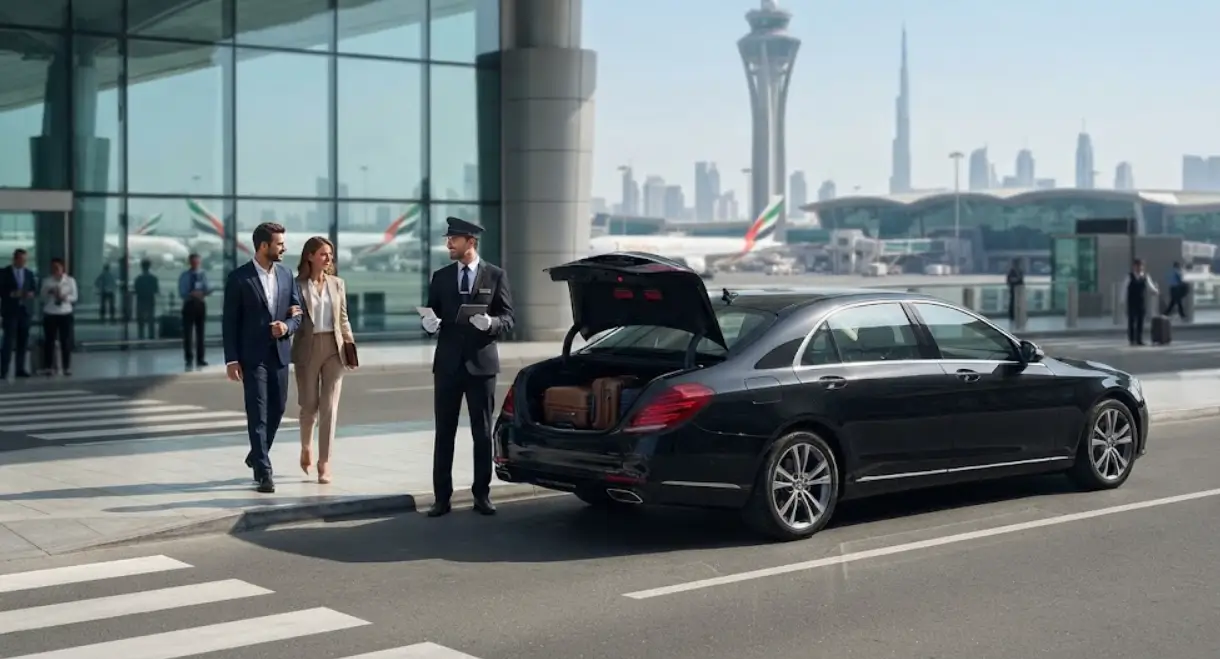
Your sixty minutes of free waiting at Dubai International begins at the updated arrival time, which means the clock starts while you are still taxiing to the stand instead of when you walk out of the terminal. Everything between those two moments is time you have already spent. Most of it is predictable once you know what governs it. White Line Limousine LLC has met flights at DXB since 2011, and this guide walks the arrival through stage by stage, so you can work out before you fly roughly where in that hour you will emerge.
Almost every chauffeur company in Dubai advertises free waiting on airport collections, and almost none of them explains how the allowance is measured, which is the part that decides whether it has any value to you at all.
Our terms give sixty minutes of free waiting on airport arrivals, measured from the updated arrival time. The word doing the work there is updated. If your flight lands ninety minutes late, the sixty minutes runs from the new landing time instead of the time printed on your ticket. That is what makes the allowance useful.
Other transfers carry fifteen minutes, so the airport figure is four times the standard. The difference exists because an airport arrival has a long and variable tail that a hotel pickup never has.
In practice, your free hour covers the whole process described in this guide. Taxiing, disembarking, walking, passport control, baggage, customs and the walk to the car all come out of it. Clearing in twenty five minutes leaves you thirty five minutes of slack. Clearing in seventy leaves none, and the vehicle’s hourly rate begins.
So the question worth answering before you fly is a simple one. Roughly where in that hour will you emerge? The rest of this guide answers it stage by stage.
The first gap in an arrival is the one almost nobody counts, and on a busy morning at Dubai International it can run to a quarter of an hour on its own before anything else has happened.
A flight tracker shows wheels down. What follows is the taxi to the stand, which at a hub this size is rarely short. Then comes the wait for a jet bridge to be attached, or for buses to reach a remote stand.
Remote stands are the variable worth knowing about. When an aircraft parks away from a contact gate, passengers leave by steps onto buses, and the whole aircraft has to be moved across the apron in batches. That alone can add fifteen minutes before anybody has set foot inside the terminal.
You will rarely know in advance which you are getting. What you can do is treat the tracker’s landing time as the start of the process instead of the end of it, and tell whoever is meeting you the same thing.
Disembarking is the one stage where a choice you made weeks earlier at the seat map decides the outcome, and the effect on your arrival is larger than most travellers would guess.
On a widebody aircraft carrying several hundred passengers, the difference between row 6 and row 58 is routinely twenty minutes at the door. On a full A380 it can be more. Nobody books a seat for this reason, and yet it reorders the entire arrival.
Hand luggage compounds it. Passengers pulling large cabin bags out of overhead lockers slow the aisle, and a full flight empties at the pace of its slowest row.
If you are flying with a tight onward schedule and you have a choice of seat, a forward seat is worth more to your arrival than it is to your flight. If you are travelling with children, expect to be among the later passengers off whatever your row, because gathering a family takes time a solo traveller never spends.
Dubai International sits among the largest terminal complexes in the world, and the distance from an aircraft door to passport control is a real component of your arrival instead of a detail you can ignore.
Concourses are long, and that walk comes out of your free hour like every other stage. The walk from a far gate can take ten to fifteen minutes at an ordinary pace. Some arrivals involve a train between concourses, which adds a wait as well as a journey.
Travelators help, and they do not cover every stretch. A traveller with mobility limitations, a family moving at a child’s pace, or anybody carrying heavy cabin baggage should plan for the upper end of that range.
The practical consequence for a booked collection is worth stating plainly. Two passengers on the same flight, one from a near gate and one from a far one, can reach passport control fifteen minutes apart before any queue is involved. That variance sits inside your free hour whether you planned for it or not.
Passport control produces the widest spread of outcomes of any stage in the arrival, and Dubai Airports publishes enough detail that you can work out in advance which side of that spread you will land on.
Dubai Airports describes Smart Gates as an advanced passport control system at both DXB and DWC, which lets eligible guests pass through, in its words, typically within seconds.
The published eligibility list names four groups. UAE and GCC nationals qualify. UAE residents qualify. Visa on arrival guests holding biometric passports qualify. Returning tourists holding biometric passports qualify.
Two details in that list surprise the guests who ask us about them. Visa on arrival guests with biometric passports are eligible, so a first time visitor from a listed country has a real chance of using the gates. And first time users are registered at the passport control touchpoint on arrival, which means registration happens as part of your first entry instead of requiring anything beforehand.
Once registered, the process is contactless. The published guidance is that registered users pass by looking at a green light, with no document to scan. Dubai Airports advises removing face coverings such as masks, glasses and hats, and having your passport and boarding pass ready. A Smart Gates PreCheck tool is published for anybody who wants to confirm eligibility before travelling.
GCC citizens have the simplest position of all. No visa, permit or sponsorship is required, and the published guidance is that they present a GCC passport or national ID card at the airport.
Here is the provision that should change how a family plans an arrival at Dubai International, and we have yet to see it mentioned on a single transfer page anywhere in this market.
Dubai Airports publishes a list of guests who cannot use the Smart Gates. It names People of Determination, guests with large strollers, families with children, and guests under 1.2 metres tall.
Read that against a single flight and the consequence is stark. A solo business traveller with a biometric passport clears in seconds at a gate. A family of four off the same aircraft, with a stroller and a child under 1.2 metres, joins the counter queue instead. Same flight, same minute of landing, materially different clearance times.
For anybody travelling as a family, that is the most useful fact in this guide, and it carries three consequences.
Expect the counter instead of the gate, and build the queue into your plan before the day arrives. Send the flight number when you book, because tracking the aircraft is what protects the free hour you are now more likely to use. And consider meet and greet, covered further down, since help inside the terminal is worth most to exactly the travellers the Smart Gates exclude.
None of this is a complaint about the rule, which exists for sound reasons around identity verification and child safeguarding. It is published information that changes how you plan.
Dubai Airports notes that some visitors may have to complete an eye scan at passport control, and it is a step worth knowing about in advance instead of meeting cold at the head of a queue.
The published guidance frames it as something certain visitors may be asked to do. It is a short process. The thing that makes it feel longer is arriving at it without expecting it.
Treat it as a possible extra step inside your passport control stage. For a traveller already in the counter queue it adds little. For somebody who expected a seconds long Smart Gate transit, it is the difference between the top and the bottom of their own estimate.
The wider point holds for every stage in this guide. Few of these steps are slow on their own. Arrivals run long when two or three of them run long together, and an unexpected step is the one most likely to start that chain.
The visa position for Dubai is published in full, and it is the one point in the arrival where going to the correct authority matters, because being sent to the wrong one costs real time.
Dubai Airports states that citizens of the listed countries, which include Australia, Canada, the United Kingdom and the United States among others, are eligible for a free visa on arrival. Citizens of countries outside that list need a visa before travelling.
The authority for Dubai visas is the GDRFA, the General Directorate of Residency and Foreigners Affairs. Dubai Airports publishes a contact number of 800 5111 from within Dubai, along with an international number on the same page, and it directs travellers to the GDRFA for cost and procedure.
The detail most useful on the ground is the location. The GDRFA visa office sits in Terminal 3 arrivals near Entrance 1, and it is open twenty four hours. If something needs resolving on arrival, that is where it gets resolved, at any hour of the night.
One caution, stated in the source itself and repeated here deliberately. Visa rules change, and Dubai Airports advises confirming requirements with your airline, the GDRFA and the Ministry of Foreign Affairs. Nationality lists in particular move, so check at source close to travel and treat any article, this one included, as a starting point.
Baggage reclaim gives you the least control of any stage and the widest variance of any stage, which is the combination that most often costs a well planned arrival its margin.
The first bags typically reach the belt a little after the first passengers do. The last bags can arrive a long time after that. Priority tags help, and they guarantee nothing about your position in the unload. Aircraft size matters too, since a full widebody produces several hundred bags from one flight.
The useful framing is that baggage time runs in parallel with everything before it. A passenger who clears passport control quickly often waits at the belt. A passenger who queued at a counter may find their bag already circulating. Clearing immigration fast does not always mean leaving faster.
For a chauffeur collection, bag count changes your timing as well as your vehicle. A family with five cases waits for five cases, and the last one sets the pace. That is also why we ask for the bag count alongside the head count. The vehicle has to take the luggage, and the timing has to allow for it.
Travelling with hand baggage only removes this entire stage. On a tight schedule that single decision is worth more than any other.
Customs is usually the shortest stage of the arrival and occasionally the longest, and that combination is exactly what makes it hard to plan around with any confidence.
Most arriving passengers walk straight through. Some are selected for a check, and a check takes as long as it takes. Nothing about this stage is predictable at the level of one traveller.
What you can do, while the chauffeur is already waiting outside, is avoid the avoidable. Know the allowances for anything you are carrying, and be ready to declare whatever requires declaration. A traveller who knows their own position moves through a check quickly. A traveller who does not is the one who takes longest.
There is one practical point for chauffeur bookings here. A check happens after your bags are off the belt, which means it lands at the very end of the arrival, when the vehicle is already waiting. Of all the stages, this is the one most likely to push an otherwise comfortable arrival past the hour.
Treat it as a short stage with a long tail, and leave it out of the estimate you give us while knowing that it exists.
After customs comes the stage that defeats more arrivals than any queue in the terminal, which is the plain business of locating the person who came to meet you.
The arrivals hall at a terminal the size of Terminal 3 is a large, crowded space with several exits. A chauffeur standing in the wrong half of it is as absent as one who never came. This is why the meeting point belongs in the booking instead of in a phone call made after you emerge.
For a pre booked vehicle at Terminal 3, Dubai Airports operates a dedicated arrangement for guests with pre booked hotel, limousine or tour operator transport. It replaces scanning a crowd for a name board with a kiosk process that identifies your assigned vehicle and driver. We will tell you at booking whether your arrival is handled that way or at the standard arrivals meeting point, since it depends on the terminal and the booking.
For Terminals 1 and 2 the chauffeur meets you in arrivals in the ordinary way, after the exit from baggage reclaim. Our airport transfer services page carries the current arrangement, and we confirm your specific meeting point in the booking email instead of leaving it to the day.
Bring a phone with working roaming or a local eSIM. Almost every arrival problem that reaches us has turned out to be a communication problem, with the car already in place.
A surprising share of airport difficulties in Dubai start with one wrong assumption about geography, and it costs more time on the day than any immigration queue ever will.
Dubai International’s terminals are separate buildings served by different roads. Terminals 1 and 3 are reached from Airport Road. Terminal 2 sits on the other side of the airfield on Al Quds Road and is approached from a different direction entirely.
The consequence is that a chauffeur sent to the wrong terminal has made more than a small error. They have to leave the airport road system and re-enter it from another approach, which on a busy evening is a substantial delay sitting squarely inside your free hour.
So the terminal on your ticket is the terminal we need, and it is worth checking instead of assuming. Airlines move terminals, and the terminal an airline used on your last visit guarantees nothing about this one. Dubai Airports itself advises confirming with your airline before you travel.
Dubai has a second airport as well, Al Maktoum International at Dubai South, which is a different journey entirely and priced separately through our Al Maktoum airport transfer service. Check which airport your flight uses, because the two sit nowhere near each other.
An airport collection is the one journey where luggage decides the vehicle, and our rate card publishes a passenger figure and a luggage figure separately for every car precisely because the two rarely match.
The Lexus ES 300h publishes three passengers and three bags, from AED 400 for a five hour block and AED 700 for ten hours. For two business travellers with a case each, that is the standard airport car and it has room to spare.
The BMW 5 Series publishes three passengers and four bags, from AED 500 and AED 900. The extra bag is the whole point of it. Three colleagues arriving with four cases between them fit the 5 Series and overload a three bag saloon.
The Toyota Previa publishes seven passengers and seven bags, from AED 400 and AED 700. A family of five with five cases belongs here, and the price matches the Lexus despite more than double the luggage capacity. Our seven seater car rental page carries the full group.
For a larger party off one flight, the 14 Seater High Roof publishes fourteen passengers and ten bags, from AED 500 and AED 800. A group of twelve with ten cases travels together in one vehicle and reaches the hotel together.
Send both numbers when you book. Passengers alone is the figure that produces a vehicle too small for the cases, and the discovery happens at the kerb.
Families carry the heaviest arrival at DXB, since they are the group the Smart Gates exclude, and UAE traffic law sets requirements for the car itself that are worth settling before you land.
As reported by Gulf News, seat belts are mandatory for all passengers in the UAE including those in the rear, and a driver faces a fine of AED 400 and four black points for a passenger travelling unbelted. The responsibility sits with the driver, which is why our chauffeurs take it seriously.
The published rules on children are specific. A child seat is required for a child under four. Children under ten travel in the rear. A front seat passenger must be at least 145 centimetres tall and at least ten years old.
For an airport arrival, those rules have one practical effect. Tell us the ages of any children travelling when you book, so the right seat is fitted before the car reaches the terminal. A chauffeur who learns about a two year old at the kerb cannot solve it there.
The same information helps on the other side of the arrival too. A family expecting the counter queue, carrying a stroller, with four cases and a child seat to fit, is a different booking from four adults with hand luggage, and both the vehicle and the timing should reflect that.
People of Determination appear on the published list of guests who cannot use the Smart Gates, which means an accessible arrival at DXB runs through the counter and deserves planning well in advance.
Dubai’s tourist transport framework, Executive Council Resolution No. 107 of 2023, requires operators to meet accessibility standards for People of Determination in the vehicles and services they provide. That is a regulatory obligation on licensed operators in this emirate, and it is the baseline anybody booking should expect.
What matters on the day is the detail you give us in advance. Tell us whether a wheelchair travels with the passenger and whether it folds, since a folding chair occupies luggage space that the rate card already publishes. Tell us if the passenger needs help from the arrivals hall to the vehicle. Tell us if airport assistance has been arranged with the airline, because that changes where and when the passenger emerges.
Meet and greet is usually the right service here instead of a standard kerbside collection. The counter queue, the baggage wait and a long walk through a large terminal are all easier with somebody alongside, and that is precisely what the service buys.
Give us this information at the booking stage and it goes into the email confirmation with everything else, so the chauffeur arrives already knowing what the arrival needs.
Travellers on a long connection through Dubai sit in a position that the standard airport transfer page never addresses, and the arithmetic deserves working through before anybody books anything.
A connection long enough to leave the airport turns into two journeys, each with a clock of its own. You clear immigration on the way in, which means every stage in this guide applies, and then you repeat the departure process in reverse to catch your onward flight.
The arithmetic decides whether a transfer booking is worth making at all. A six hour connection minus a full arrival, minus a return trip with an airline check in deadline, minus the road in both directions, leaves considerably less usable time in the city than the gap on the ticket suggests. A shorter connection rarely leaves any.
Where a connection is long enough, the sensible booking is an hourly block covering the whole gap instead of two separate transfers. The vehicle stays with you, the chauffeur waits while you do whatever you came out to do, and the return to the terminal is planned against your check in deadline from the start.
Two things decide whether this works. Your passport has to allow entry to the UAE, which sends you back to the visa section above. And your bags have to be checked through to your final destination, because collecting and re-checking them consumes much of what you were hoping to save.
Al Maktoum International at Dubai South is the emirate’s second airport, and an arrival there differs from DXB in almost every respect that affects your transfer and its price.
Dubai Airports lists Smart Gates at DWC as well as at DXB, so the eligibility rules in this guide apply at both. The published exclusions apply at both too, which means a family arriving at Al Maktoum should expect the counter queue there as well.
The difference is scale and road position. DWC sits well to the south west of the city, so the drive to Downtown, Dubai Marina or Deira is a longer journey than the same trip from DXB. That distance is the reason it is priced separately on our rate card instead of being folded into the DXB figure.
The stages themselves are shorter in a smaller terminal. The walk is shorter, the arrivals hall is easier to read, and locating a chauffeur is a simpler business than it is at Terminal 3. What you gain inside the building, you spend on the road.
The booking advice is identical. Send the flight number, the terminal and your passenger and luggage counts, and confirm which of Dubai’s two airports your flight uses before you travel.
Put all of the stages together and the sixty minute allowance stops being an abstract promise, which is the entire point of walking through them one at a time.
A solo traveller with a biometric passport, seated forward, arriving at a contact gate, eligible for the Smart Gates and carrying hand baggage only can be in the car comfortably inside half an hour. That traveller never thinks about the free hour because they never come close to it.
A family of four at a remote stand, off a far gate, excluded from the Smart Gates, waiting on four checked bags, is working with different arithmetic entirely. Fifteen minutes to disembark, fifteen to walk, a counter queue, a wait at the belt and a crowded arrivals hall adds up quickly, and the hour can be gone.
Neither of those is a failure of anybody’s service. They are two different arrivals. The only real mistake is assuming your arrival will behave like the first when it has the shape of the second.
Which is why the free hour is best understood as insurance, which is a different thing from a budget to spend. It exists so a delayed flight, a slow belt or a remote stand stops short of becoming a charge. Arrivals that use all of it are usually arrivals where several variables ran long at once.
Most of what determines your arrival is fixed before you leave home, and four of those decisions are worth making deliberately instead of by default.
Send the flight number when you book, in place of the scheduled landing time. The flight number lets us track the aircraft, which is what makes the updated arrival time work in your favour.
Confirm your terminal with the airline and send it with the booking. Of everything on this list, that is the most expensive thing to get wrong.
Check your Smart Gate position honestly, using the published eligibility list and the PreCheck tool Dubai Airports provides. A family expecting a seconds long transit and meeting a counter queue has mis-planned the whole arrival.
Send the bag count with the head count. It sets the vehicle, and on our rate card the two figures move independently. Three passengers with four cases are a different booking from three passengers with three.
A standard collection meets you after you emerge into the arrivals hall, while meet and greet meets you earlier in the process, and that distinction matters most to the travellers the arrival treats worst.
Consider it for families with young children. Consider it for anybody the published rules exclude from the Smart Gates, for elderly passengers, for travellers arriving with substantial luggage, and for a first visit to a terminal the size of Terminal 3.
Consider it too for arrivals where the onward schedule has no slack at all. Being met earlier removes the arrivals hall problem completely, since you are accompanied through it instead of searching it.
Our airport meet and greet service covers assistance inside the terminal. For a straightforward arrival by an experienced traveller with hand baggage, a standard collection does the job and the extra service earns less.
The honest version of the advice is that meet and greet is worth most to the people who need it and least to the people who do not. The published Smart Gate rules are a reasonable way to work out which of those you are.
Everything above describes an arrival, and a departure runs in the opposite direction from a completely different starting figure, which is why it needs a section of its own.
Work backwards from your check in deadline, which is the figure we actually need. Airlines set their own check in and bag drop cut offs, and the one on your booking is the one that matters. We set the pickup from that deadline, allowing for the road, the terminal and the walk inside it.
Build in the terminal itself, which we allow for when we set the pickup. At a building the size of Terminal 3, the distance from kerb to gate is substantial, and a passenger arriving at the deadline has arrived late by the time they reach security.
Peak departure banks are the other factor. DXB has periods when a large number of flights push within a short window, and the roads approaching the terminals show it. An evening departure inside a peak bank needs more road allowance than the same journey at a quiet hour.
For departures we apply the standard fifteen minutes of free waiting instead of the airport arrival figure, since the sixty minute allowance exists for the variability of arrivals specifically.
One line in our terms deserves explaining in full instead of sitting in small print, because it is the only exclusion on a rate card that is otherwise completely inclusive.
Every published rate covers the chauffeur, fuel, Salik tolls, insurance, VAT and parking, and it excludes airport parking. Airport car parks are charged by the airport operator, and the charge depends on the terminal and the duration.
For a standard collection this rarely arises, because the vehicle is moving instead of parked. It becomes relevant when an arrival runs long enough that the chauffeur has to enter a paid car park, or when you book meet and greet, which by its nature means the chauffeur is inside the terminal while the vehicle waits.
We will tell you when it applies instead of letting it appear afterwards. The general principle on our rate card is that the quoted figure is the figure you pay, and this exclusion is published precisely so that principle stays true.
Sixty minutes of free waiting on arrivals from the updated arrival time is the headline of an airport booking, and the rest of the arrangement is built around making that hour do its job properly.
Chauffeurs are RTA approved, speak English and Arabic, and reach the pickup point before the booked time. Every booking, change and cancellation is confirmed to you by email, which on an airport arrival means the terminal, the meeting point and the flight number all exist in writing before you travel.
Cancellation is free twenty four hours or more before pickup. A cancellation inside eight hours, or a no show, is charged in full.
Published rates run from AED 400 for a five hour block on the Lexus ES 300h at three passengers and three bags, and the Toyota Previa sits at the same AED 400 with seven passengers and seven bags. Payment is by American Express, Mastercard, Visa or PayTabs, with 5 per cent VAT applied.
For a stay where the airport run is the first of many journeys, a standing car with a driver service in Dubai arrangement is usually simpler than booking each leg one at a time.
At the updated arrival time, so it begins while you are still on the aircraft. A delayed flight moves the start of the hour instead of consuming it, which is why we ask for the flight number at the booking stage.
Dubai Airports lists four eligible groups: UAE and GCC nationals, UAE residents, visa on arrival guests with biometric passports, and returning tourists with biometric passports. A PreCheck tool is published for confirming your eligibility before you travel.
Dubai Airports publishes that families with children, guests with large strollers, People of Determination and guests under 1.2 metres tall cannot use them. Families should expect the counter queue and plan the arrival around it.
It depends on the stage you are weakest at. A solo traveller with hand baggage, a forward seat and Smart Gate eligibility can be out in well under half an hour. A family at a remote stand waiting on checked bags can take most of an hour.
Visa on arrival is free for citizens of the countries Dubai Airports lists. The GDRFA visa office is in Terminal 3 arrivals near Entrance 1 and is open twenty four hours. Confirm requirements with your airline and the GDRFA before travelling, since the rules change.
Nothing changes at your end provided we have the flight number. The sixty minutes runs from the updated arrival time, so the chauffeur’s start moves with the aircraft.
The one on your ticket, which you should confirm with your airline. Terminals 1 and 3 are reached from Airport Road and Terminal 2 sits on the other side of the airfield, so the terminal changes both the route and the meeting point.
UAE rules require a child seat for a child under four, and children under ten travel in the rear. Tell us the ages of any children when you book, so the seat is fitted before the car reaches the terminal.
Meet and greet is worth most to families, elderly travellers, anybody excluded from the Smart Gates and anyone arriving with substantial luggage. An experienced traveller with hand baggage rarely needs it.
No. Every published rate includes the chauffeur, fuel, Salik, insurance, VAT and parking, and excludes airport parking, which the airport operator charges. We tell you when it applies instead of adding it afterwards.
Send your flight number, your terminal, the date, and your passenger and luggage counts, and tell us if you are travelling with children or with anyone who will need assistance through the terminal. We will confirm the vehicle, the meeting point and a fixed inclusive price in writing before you fly. Call +971 4 385 8433, email booking@wllimo.com or message us on WhatsApp.
Need a Car with Driver in Dubai?
White Line Limousine — luxury cars with professional chauffeurs, from AED 400 per half day. Airport transfers, city tours and inter-Emirate travel across the UAE.
WhatsApp Us Now Call +971 55 432 3136