Bus Rental Dubai: What the Law Requires of Your Bus
- Home
- Bus Rental Dubai: What the Law Requires of Your Bus


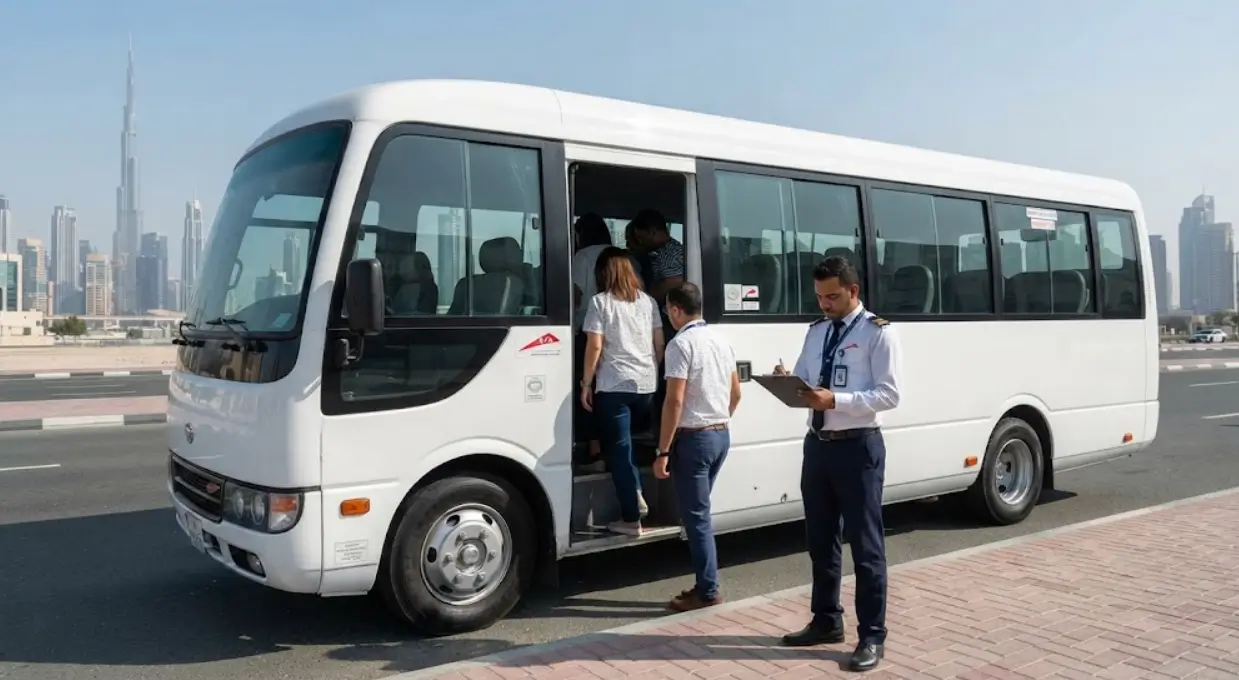
Dubai sets out in writing what a passenger bus must carry, how its seatbelts must be specified, and who is permitted to drive it. Almost nobody hiring a bus ever reads any of it. The requirements sit in two published resolutions, one covering buses and one covering tourist transport, and between them they settle questions most operators answer with a shrug. White Line Limousine LLC has run vehicles across Dubai since 2011. This guide works through what those resolutions say, so you can check the bus you are about to hire against the standard it is held to.
Start with a definition, because it decides which rules apply to your booking and almost no quote you receive will mention it.
Article 3(b)(3) of Dubai’s bus resolution requires that a bus have at least fourteen seats. Below that number the vehicle is something else, and the bus specific requirements in that resolution are written for vehicles at or above the line.
Set our own fleet against it and the line falls in an interesting place. The 12 Seater Toyota Hiace publishes ten passengers, which puts it below fourteen and on the van side. The 14 Seater High Roof publishes fourteen, landing exactly on the threshold. The 22 Seater and 30 Seater Toyota Coasters sit comfortably above it.
That matters when you are comparing quotes. A fourteen seat vehicle and a twelve seat vehicle are different categories of thing in Dubai, even when an operator lists them side by side on the same page under the same heading. Ask which you are being quoted, because the answer changes the standard the vehicle is held to.
Two separate pieces of Dubai legislation govern this area, and they do quite different jobs, so it is worth knowing which one answers which question.
Administrative Resolution No. 201 of 2012 sets the standards and requirements for transporting passengers by buses in Dubai. It is the document that specifies the fire extinguisher, the belts, the emergency exits and the driver permit.
Executive Council Resolution No. 107 of 2023 regulates tourist transport activity in the emirate, which it defines as carrying passengers by tourist vehicles to and from airports, hotels, tourist resorts and heritage, archaeological and tourist landmarks, inside or outside Dubai. That description covers a large share of what a hired coach in Dubai actually does. It was issued on 15 December 2023 and takes effect sixty days after publication in the Official Gazette, with existing operators given up to a year from that date to comply under Article 21.
One honest caveat before we go further. Parts of the 2012 resolution are plainly written for scheduled bus services, including the obligations on routes, timetables, published fares and ticket sales under Article 2. The vehicle specifications and the driver requirements are the parts that bear on a charter booking, and those are the parts this guide covers. Read the resolutions in full if your situation is unusual, and take advice if money turns on it.
Article 3(c) of the 2012 resolution lists safety equipment in a level of detail that would surprise most people booking a coach for a wedding.
A first aid kit is required under Article 3(c)(2). So is a fire extinguisher, and the resolution is specific about it: a six kilogram extinguisher located near the driver’s seat, together with a sign showing its location. The weight and the position are both written down.
Emergency window breakers are required under Article 3(c)(3), and Article 3(c)(4) requires clearly marked emergency exits commensurate with the number of seats. More seats means more exits, and the marking has to be visible.
Article 3(c)(6) prohibits sharp edges inside or outside the vehicle, which reads oddly until you picture a coach loading thirty people in a hurry.
Two smaller requirements complete the picture. Article 3(b)(6) requires emergency procedure instructions displayed prominently in Arabic and English, and Article 3(b)(7) requires a dustbin on board.
None of this is exotic equipment. The useful part for a customer is that it is specified, which means you can look for it. Step onto the coach before you sign anything. Check that the extinguisher is where the resolution says it should be, that the exits are marked, and that the emergency instructions are posted in both languages.
Here is the provision that no bus rental page in this market reproduces, and it is more precise than the general seatbelt rule people are familiar with.
Article 3(c)(5) sets the belt type by seat position on intracity buses. All passenger seats require two point belts. Three point belts are required on the seats with no seat in front of them. The resolution identifies those as the front seats, the middle seat of the last row, and the driver’s seat.
That is a design requirement on the vehicle itself, and it tells you something useful. A coach where the front row or the middle rear seat carries only a lap belt falls short of the specification written for it.
The general UAE position reinforces it. Belts are mandatory for every passenger including those in rear seats, and the driver carries the penalty when a passenger travels unbelted. On a thirty seat coach that is thirty opportunities for the operator to be liable, which is why a serious operator briefs the group before moving.
Check the belts when you board. It takes a minute and it is the single most informative thing you can do on a vehicle you are about to put thirty people into.
Article 3(b)(1) requires that the number of seats match the manufacturer’s number, and it states that no additional folding seats may be used.
That second clause is the one worth holding onto. An operator squeezing an extra row of folding seats into a coach to turn a thirty seater into a thirty four seater is outside the written requirement. You are the person sitting in the result.
So when a quote offers a capacity that sounds slightly unusual for the vehicle, ask which model it is and what the manufacturer rates it at. The published capacity should match the manufacturer, and a figure that sits a few seats above a standard configuration deserves a question.
This is also why we publish a passenger figure for each vehicle and quote from that figure instead of from the name on the side. Our 22 Seater Coaster publishes twenty two and our 30 Seater publishes thirty.
Article 3(b)(5) requires luggage racks in twenty five seater buses, which creates a threshold worth knowing when you are choosing between two coach sizes.
Below that size the requirement does not bite, so luggage storage on a smaller coach is a question to ask before you assume it. Above it, racks are specified.
For a group arriving from an airport this is the detail that decides the booking. A twenty two seat coach carrying twenty two people with cases is a different proposition from the same coach carrying twenty two people with handbags. Our 22 Seater publishes no luggage figure at all, so we confirm capacity against the vehicle when the booking involves bags.
Our 30 Seater publishes ten bags. If you are moving a group and its luggage together, say so when you enquire and we will tell you which coach takes both.
Article 3(b)(4) reserves the front seats of a bus for persons with disabilities, women and the elderly, which is a short clause with a practical consequence for anybody organising a group.
It is a short clause and it has a practical consequence for anyone organising a group. The front seats sit outside your allocation, and a tour leader planning a seating arrangement is better knowing that before boarding.
For groups including an elderly passenger or someone with limited mobility, that provision works in your favour and is worth invoking. Mention it when you book and the chauffeur will keep those seats clear.
Article 3(b)(8) requires air conditioning capable of holding the interior temperature within three degrees of twenty four degrees Celsius, which makes cooling a specification rather than a courtesy. The drafting is awkward in the English version and should be read against the Arabic original, but the intent is clear enough, since it sets a specified comfort band in place of a vague promise.
In a Dubai summer that clause is doing real work. A coach whose air conditioning struggles across thirty occupied seats in August is failing a written standard, and that is more than a disappointment.
Ask about it for any summer booking involving a full coach, because a vehicle that cools adequately with six people aboard behaves differently with thirty.
The 2023 resolution carries an obligation that very few operators raise with customers, and it is worth knowing about before you assume a group cannot be accommodated.
Article 5(4) and Article 14(12) require tourist vehicles to meet RTA safety, specification and accessibility standards, including standards for persons with disabilities. Accessibility sits in the regulation alongside the safety requirements, with the same standing as they have.
That is a useful thing to be able to cite. A group including a wheelchair user, an elderly passenger with limited mobility or somebody recovering from surgery has a reasonable question to ask, and the regulation gives it a footing.
What it does not do is guarantee that every vehicle in every fleet is equipped. Standards exist and fleets vary, so the practical step is to ask the operator directly what the specific vehicle offers, and to ask early enough that an alternative can be arranged.
Be concrete when you ask. A folding manual wheelchair stowed in a luggage compartment is a different request from a passenger who needs to board and travel seated in their own chair. The second needs a vehicle fitted for it. Tell us which applies and we will tell you plainly what we can and cannot do on your date, and where to go if the answer is that we cannot.
Article 4 of the 2012 resolution sets out who may drive a bus in Dubai, and the list is longer than most passengers would guess.
A Public Transport Agency permit is required before driving a bus at all, under Article 4(a). On top of that the driver needs a driving licence for the specific bus type under Article 4(a)(1), and completion of driver training courses under Article 4(a)(2).
The minimum age is twenty five under Article 4(a)(3). Good character and repute is required under Article 4(a)(4), and a black points report under Article 4(a)(5).
Article 4(a)(6) requires a certificate showing the driver is free of disease, along with proof of being free of drugs and alcohol. Article 4(a)(8) requires literacy in Arabic and English, and Article 4(a)(9) requires passing the Agency’s theoretical test.
The permit has to be carried while driving under Article 4(a)(7), and Article 4(b) makes it valid for one year and renewable for the same period. Article 4(c) lets an operator ask the Agency to cancel a driver’s permit when that driver leaves its service.
Read as a set, that is a substantial qualification. It is also checkable, because the permit is a document the driver is required to have on them. A customer who asks to see it is asking for something the driver should be carrying anyway.
Our own chauffeurs are RTA approved and speak English and Arabic. For a coach booking, ask us which permit the driver holds for that vehicle class and we will tell you.
Resolution 107 of 2023 regulates the commercial side of tourist transport, and unusually for a document of its kind it publishes a full fee schedule, which turns out to be more useful to a customer than it first appears.
Article 4(a) is the core prohibition: no natural or legal person may conduct the activity in the emirate unless authorised by the RTA and licensed by the commercial licensing authority. Hotel establishments carrying their own guests and tourist establishments carrying people to other places within Dubai are carved out under Article 3(b), subject to RTA and Department of Economy and Tourism rules.
The permits come in layers. An Establishment Permit runs for one year and is renewable, with a fee of AED 4,000 under Schedule 1. A Tourist Vehicle Permit is priced by category under Article 13(a)(1): AED 1,500 for heavy vehicles, AED 700 for light, AED 500 for a tourist motorcycle, and AED 800 for other types. A Tourist Vehicle Driver’s Permit costs AED 200 a year under Article 13(a)(2).
Training carries its own published prices in Schedule 1: AED 1,000 for the basic course, AED 400 for the supplementary course and AED 400 for re-qualification. Drivers must be enrolled in RTA prescribed training under Article 14(6).
Renewal applications go in during the last month before expiry under Article 8. The establishment’s manager must be at least twenty one under Article 7(6).
Those are real numbers from a published schedule, and they tell you something a quote never will. Compliance has a cost. An operator quoting far below the market may be carrying less of it than the one quoting above.
Two obligations under Article 14 of the 2023 resolution happen to be visible from outside the vehicle, which makes them the easiest things on this entire list for a customer to check.
Article 14(7) requires the establishment’s name and contact details to be displayed in a prominent place inside and outside the vehicle. Article 14(9) requires tracking devices to be installed as the RTA specifies, and Schedule 2 lists the tourist transport plate among the requirements.
So an unmarked coach with no operator name on it is worth a question. The name is supposed to be there, inside and out, and its absence tells you something before you have asked anybody anything.
Article 14(3) restricts tourist vehicles to the activity itself, and Article 14(10) prohibits letting another establishment use your vehicles without RTA approval. That second clause matters on busy dates, when a shortage of coaches tempts some operators to subcontract quietly. Ask whose vehicle will actually arrive.
Several obligations in both resolutions fall on the operator instead of the vehicle, and they shape the service you receive even though you never see them happen.
Article 2 of the 2012 resolution requires operators to register buses under RTA procedures, meet the authority’s safety and security requirements, and carry out periodic maintenance. The resolution sets no inspection frequency, so maintenance intervals are a question for the operator, with no figure published to look up.
The 2023 resolution adds record keeping. Under Article 14, an establishment must report its fares per person to the RTA and keep trip records. It must also enrol drivers in RTA prescribed training, install tracking devices as specified, cooperate with RTA employees, and comply with traffic, public health, safety and environmental laws.
Trip records are the part worth noting as a customer. An operator keeping proper records can tell you which vehicle went where and with which driver, which matters when something needs resolving after the event has finished.
Article 14(5) also requires RTA approval before placing advertisements or posters on a vehicle. If you are planning branded livery on a coach for a conference or a wedding, that approval is the operator’s to obtain. Raise it at the enquiry stage instead of the week before.
Schedule 2 of the 2023 resolution sets fines ranging from AED 500 to AED 10,000, and conducting the activity without a permit sits at the top of that range at AED 10,000.
Article 16(b) doubles a repeat violation within one year, capped at AED 50,000. Article 16(c) gives the RTA power to suspend a permit for up to six months, revoke permits, cancel the commercial licence, or impound a vehicle for up to six months.
Article 17 adds that a violator must fix the violation within the RTA’s deadline, failing which the RTA may fix it and charge the cost plus twenty five per cent in administrative charges. Article 19 gives affected parties thirty days to file a grievance.
The reason this concerns a customer as much as an operator is the impound power. A vehicle held for up to six months will not be arriving for your event. An operator running without the right permit is carrying a risk that becomes your problem on the morning it crystallises.
Everything above turns into a short list of questions you can put to any operator, and working through the whole list takes about five minutes.
Ask which vehicle you are being quoted, by model and published passenger figure, and whether that figure matches the manufacturer’s configuration. Ask whether the vehicle sits above or below the fourteen seat line.
Ask what permits the operator holds for the activity and for that vehicle, and what permit the driver holds for that vehicle class. Ask whether the vehicle carries the operator’s name inside and out, because the resolution requires it.
Ask whether the coach that arrives will be the operator’s own vehicle or a subcontracted one, since Article 14(10) requires RTA approval for letting another establishment use your vehicles.
Then, on the day, look for the six kilogram extinguisher near the driver and the sign showing where it is. Check the marked exits, the emergency instructions in Arabic and English, and the belt types on the front row and the middle seat of the last row.
An operator who welcomes those questions is telling you something. So is one who does not.
Groups often reach for several cars because it feels more flexible, and the published figures make the comparison straightforward enough to settle in a minute.
Our executive saloons publish three passengers each. Moving twenty two people in saloons therefore takes eight vehicles, and at the published AED 400 five hour rate that comes to AED 3,200. The 22 Seater Coaster covers the same twenty two people for AED 650.
Scale it up and the gap widens. Thirty people in saloons takes ten vehicles at AED 4,000 for five hours, against AED 650 for the 30 Seater Coaster.
Seven seat people carriers narrow it without closing it. Twenty two people fit four Toyota Previas, which at AED 400 each comes to AED 1,600 against the coach at AED 650.
Those are arithmetic on our published rates instead of quoted package prices, and they ignore the things that favour cars, which are real. Several vehicles can serve several destinations, they reach doors a coach cannot, and a late passenger delays one car instead of thirty people. The honest summary is that a coach wins decisively on cost for a single origin and a single destination, and cars win on flexibility when the group splits.
Tell us the shape of the movement and we will price both. On a surprising number of enquiries the answer is a coach for the main leg and a car or two for the people whose timings differ.
Here is our side of it, taken from our published fleet figures so you can hold us to the same standard this guide asks you to apply to everybody else.
The 22 Seater Toyota Coaster publishes twenty two passengers at AED 650 for five hours and AED 1,000 for ten. The 30 Seater Toyota Coaster publishes thirty passengers and ten bags at the same AED 650 and AED 1,000.
Below the coaches sit the larger vans. The 14 Seater High Roof publishes fourteen passengers and ten bags at AED 500 and AED 800, which places it on the bus side of the fourteen seat line. The 12 Seater Toyota Hiace publishes ten passengers and seven bags at the same rates, which places it on the van side despite its name.
One more comparison is worth making while we are being specific about our own figures. The 14 Seater High Roof and the 12 Seater Toyota Hiace carry the same AED 500 and AED 800 rates, and they publish fourteen passengers and ten bags against ten passengers and seven bags. Four more seats, three more bags and the bus side of the fourteen seat line, for the same money. Where both would serve, the larger of the two is the better booking.
Two gaps in our own published figures are worth stating plainly, because this guide is about checking published information. The 22 Seater Coaster publishes no luggage figure and the Mercedes Sprinter publishes no passenger figure. We confirm both against the vehicle at booking instead of quoting a number our fleet page does not carry.
Groups larger than thirty should ask before planning, and we will confirm what is available on your date. Our bus work also runs from the northern emirates through bus rental in Sharjah.
The resolutions settle what the vehicle must be, and Dubai’s built environment settles where it can go. That is the other half of a coach booking, and the half more likely to disrupt your day.
A thirty seat coach is long, tall and heavy, and a great many places a car reaches easily are closed to it. Multi storey car parks have height barriers. Hotel forecourts are frequently designed around saloons and taxis. Residential compounds have gates sized for family vehicles.
So the pickup point for a coach is chosen in advance. Tell us the venue and we will name a point the coach can legally and physically reach. That is often a service road, a designated coach bay or a nearby kerb instead of the entrance itself. For a hotel, the concierge usually knows exactly where coaches are directed, and a call ahead settles it.
Build the walk into the schedule. A group of thirty moving from a coach bay to a venue entrance takes longer than the same thirty people arriving in cars at the door. Put that time into the plan instead of into your start.
Airport work has its own arrangement, handled through our airport transfer services. A full day of sightseeing with a coach sits better as a Dubai city tour booking, where the vehicle waits between stops.
Knowing the recourse available before you need it is worth a short section, because the 2023 resolution sets out both a correction mechanism and a grievance route.
Article 17 requires a violator to fix the violation within the deadline the RTA sets. Where that does not happen, the RTA may rectify it and charge the operator the cost plus twenty five per cent in administrative charges.
Article 19 gives any affected party thirty days to file a grievance. That window is short enough to matter, so a dispute worth pursuing should be raised promptly instead of left to settle itself.
On our side the practical protections are simpler and sit in the booking. Every booking, change and cancellation is confirmed to you by email, which means the agreed vehicle, time and price exist in writing before anybody travels. The cancellation terms sit in the same email.
Keep the confirmation. On a group movement with several people involved in the arrangements, the email is the document that settles what was agreed. It is the first thing we will ask you for if a question arises afterwards.
Recurring group transport behaves differently from one off hires, and the difference is worth planning around before week three teaches it to you.
A school run or a staff shuttle is the same journey repeatedly, which makes consistency the thing you are buying. The same vehicle and the same driver each day means a driver who knows the gate, the route, the timings and the faces. That familiarity does more for a daily movement than any specification does.
Recurring work also changes the commercial shape. A standing arrangement is priced on the pattern across the month instead of as a series of separate bookings, so send the timetable and we will quote against it. Group rates for multi day arrangements are quoted per booking and remain unpublished, so there is no figure to look up.
The capacity question matters more here too. A daily movement sized exactly to the group leaves nothing for a visitor, a replacement or a bag day. A vehicle one tier up often costs less than the occasional second vehicle it saves.
Peak dates are the last consideration. School terms, conference season and the weeks around major events compress coach availability across the whole market. A recurring booking confirmed early protects a vehicle that a late enquiry may simply fail to find.
Six pieces of information let us quote a coach accurately, and sending them together removes the back and forth that otherwise follows.
Send the date and the times, the pickup point, the destination, the head count and the bag count. Then add the venue, because the venue decides where the coach can stop and that is the detail most likely to change the plan.
Tell us early about anything unusual. A passenger needing accessible access, branded livery requiring RTA approval, a multi stop itinerary, an airport collection with luggage or a group larger than thirty all need lead time. Every one of them is easier to solve three weeks out than three days out.
For an airport collection send the flight number in place of the scheduled time, so the sixty minutes of free waiting runs from the real arrival time.
What comes back is a named vehicle, a fixed inclusive price and a confirmed pickup point. If the coach cannot reach the entrance you had in mind, we will say so at the quote stage and propose the point it can reach. That is considerably better than discovering it with thirty people standing on a kerb.
Our published rate covers the chauffeur, fuel, Salik tolls, insurance, VAT and parking, excluding airport parking, and nothing is added after the journey.
Chauffeurs are RTA approved, speak English and Arabic, and reach the pickup point before the booked time, which on a coach booking is what makes an orderly boarding possible. Airport collections carry sixty minutes of free waiting from the updated arrival time, and other transfers carry fifteen minutes.
Every booking, change and cancellation is confirmed to you by email. Cancellation is free twenty four hours or more before pickup, and a cancellation inside eight hours or a no show is charged in full.
Group rates for multi day or per person arrangements are quoted per booking instead of published, so send the itinerary and we will price it. Recurring staff or school movements are usually better arranged as a standing corporate chauffeur booking, and smaller groups often fit a car with a driver in Dubai instead of a coach.
At least fourteen, under Article 3(b)(3) of Administrative Resolution No. 201 of 2012. Below that the vehicle is treated as something other than a bus, which is why a twelve seat van and a fourteen seat vehicle are different categories even when listed together.
A first aid kit, and a six kilogram fire extinguisher near the driver’s seat with a sign showing its location. Emergency window breakers, clearly marked emergency exits matched to the seat count, a dustbin, and emergency instructions displayed in Arabic and English.
Article 3(c)(5) requires two point belts on passenger seats. Three point belts are required on seats with nothing in front of them, namely the front seats, the middle seat of the last row and the driver’s seat.
No. Article 3(b)(1) requires the seat count to match the manufacturer’s number and states that no additional folding seats may be used.
A Public Transport Agency permit, a licence for that bus type and completed training. A minimum age of twenty five, good character and a black points report. A medical certificate showing freedom from disease, proof of being free of drugs and alcohol, literacy in Arabic and English, and a pass in the Agency’s theoretical test. The permit runs for one year and must be carried while driving.
Published fees under Resolution 107 of 2023 are AED 4,000 for an Establishment Permit and AED 1,500 for a heavy Tourist Vehicle Permit. Light vehicles are AED 700 and other types AED 800. A Tourist Vehicle Driver’s Permit is AED 200. Driver training is AED 1,000 for the basic course.
Conducting the activity without a permit carries a AED 10,000 fine under Schedule 2. A repeat within a year doubles, capped at AED 50,000, and the RTA may suspend or revoke permits, cancel the commercial licence or impound the vehicle for up to six months.
Our published coaches are the 22 Seater and 30 Seater Toyota Coasters, both AED 650 for five hours and AED 1,000 for ten. For groups above thirty, ask before planning and we will confirm what is available on your date.
Sometimes. Height barriers, forecourt design and compound gates frequently keep a coach away from the door, so we agree a reachable pickup point in advance and build the walking time into the schedule.
Send the date, the pickup point, the head count and the bag count, and tell us the venue so we can confirm where the coach can stop. We will name the vehicle, quote a fixed inclusive price and answer any of the permit questions in this guide. Call +971 4 385 8433, email booking@wllimo.com or message us on WhatsApp.
Need a Car with Driver in Dubai?
White Line Limousine — luxury cars with professional chauffeurs, from AED 400 per half day. Airport transfers, city tours and inter-Emirate travel across the UAE.
WhatsApp Us Now Call +971 55 432 3136