Rental Car Fuel Policies in Dubai: Full Tank vs Pay as You Go
- Home
- Rental Car Fuel Policies in Dubai: Full Tank vs Pay as You Go


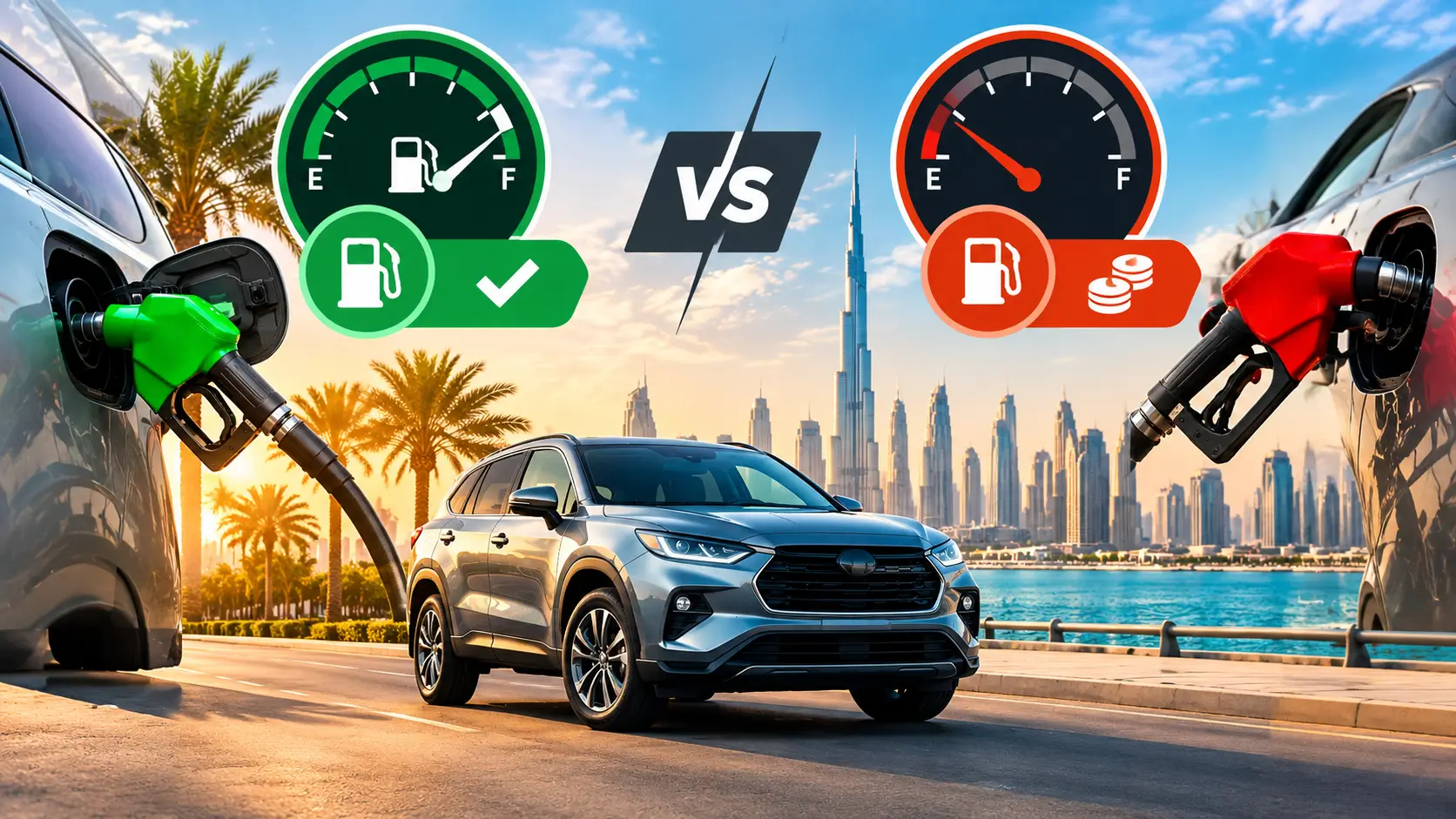
A rental car fuel policy decides who buys the petrol and at what price. On a self-drive hire in Dubai you will be offered one of three arrangements: return the car full, pay for what you use at the end, or buy a tank up front. On a chauffeured booking the question does not arise, because the fuel is inside the quoted rate and the price movement is the operator’s problem.
That distinction matters more in October 2026 than it did in September. UAE petrol prices rose by roughly sixteen per cent on 1 October, in a single monthly revision. Anybody holding a self-drive car on a pay as you go policy absorbed that increase without agreeing to it. White Line Limousine LLC runs chauffeur driven vehicles across the Emirates, and this guide explains each rental car fuel policy properly, then sets out what happens to fuel on a booking where a driver is included.
Every fuel arrangement offered in the UAE is a version of one of these three, whatever the rental desk calls it on the form.
Full to full, sometimes written as same to same. You collect the car with a full tank and you return it full. You buy your own fuel during the hire, at pump prices, at a station of your choosing. If you bring it back short, the company refuels it and bills you.
Pay as you go, also sold as same to same with settlement. You collect the car at whatever level the tank holds, the level is recorded, and at the end the difference is charged to you. You pay for exactly the fuel you burned and nothing else, settled on the invoice instead of at the pump.
Prepaid, or full to empty. You buy a full tank at the start, usually at a rate set by the company, and you may return the car at any level. Fuel left in the tank is normally forfeited. It is the convenience option and it is the one that most often costs more than it saves.
This is the mechanism underneath all three policies, and most guides skip it entirely.
UAE fuel prices are deregulated and revised monthly. The system was introduced in 2015, replacing fixed subsidised pricing, and since then the rate you pay at the pump has tracked international oil markets. Prices are announced at the end of each month by the Gasoline and Diesel Prices Follow-up Committee, carried through the state news agency, and they take effect on the first of the following month.
Four grades are priced separately: Super 98, Special 95, E-Plus 91 and diesel. A vehicle requiring 98 costs meaningfully more to run than one on 91, and nobody at a rental desk will mention it.
The practical consequence for a renter is that the price is fixed for the calendar month and unpredictable beyond it. A one-week hire sits inside a single price period. A four-week hire crossing a month boundary does not, and the renter carries whichever way the revision goes.
A live example of exactly that risk, and the reason this post exists at all, because the figures below are the clearest demonstration available of why the fuel line on a hire agreement deserves attention.
According to Khaleej Times, reporting the committee’s announcement, the October 2026 prices were set as follows. Super 98 moved to AED 4.40 a litre from AED 3.80. Special 95 moved to AED 4.28 from AED 3.69. E-Plus 91 moved to AED 4.21 from AED 3.61. Diesel moved to AED 4.80 from AED 4.30.
That is roughly 60 fils added to every litre of petrol, an increase of about sixteen per cent in one month. Diesel rose by 50 fils, close to twelve per cent.
The same report works it through on a full tank, using average tank capacities. A 62 litre sedan filled with Special 95 cost AED 265.36 in October against AED 228.78 in September, a difference of AED 36.58 on a single fill. A 74 litre SUV on the same grade moved from AED 273.06 to AED 316.72, a difference of AED 43.66. On a monthly self-drive hire with several fills a week, an identical driving pattern costs materially more in October than it did in September, for reasons that have nothing to do with the hire agreement you signed.
That is the whole case against pay as you go on a long booking. The policy transfers a volatile cost to the person least able to forecast it.
The most common policy on the market, and the fairest of the three when it is administered properly, which is why it is worth understanding the three specific points at which the administration tends to slip.
The appeal is straightforward. You pay pump prices at a station you choose, which means you pay the true market rate with no intermediary. On a short hire with light mileage, the amounts involved are small and the arrangement is clean.
Three things go wrong with it, and all three are avoidable.
The level at collection is recorded loosely. A gauge sitting a needle’s width below full at pickup becomes your liability at return. Photograph the gauge before you drive away, with the ignition on so the needle reads true.
Returning it full means genuinely full. Topping up at a station two junctions from the drop-off point leaves the gauge slightly down after the drive, and that is enough to trigger a refuelling charge. Fill at the nearest station to the return point and keep the receipt.
Refuelling on your behalf carries a service element. Where a company refuels a car returned short, the charge covers the fuel and the labour of doing it, and that second part is where the cost sits. The fuel itself is rarely the expensive half.
Marketed as the fair option, and on the right hire it is. The problem is that the hires it suits are narrower than the marketing suggests.
You pay for the fuel you consume, measured from the recorded level at collection to the recorded level at return. No forfeited tank, no refuelling run before drop-off, no receipt to keep. For a traveller on a tight schedule returning a car at an airport before a flight, removing the refuelling stop has real value.
Two conditions decide whether it works out.
The rate at which the fuel is priced. If the settlement uses the published pump price for the grade, the policy is sound. If it uses a company rate, you are paying a margin on every litre, and the margin is invisible because it sits inside a single line on the final invoice.
The month boundary. On a hire inside one calendar month, the price is known at the start. On a hire crossing into a new month, part of your fuel is priced at a figure that did not exist when you signed. The October revision made that abstract risk concrete.
Ask one question at the desk: is the fuel settled at pump price or at a company rate? The answer separates a fair policy from an expensive one, and it takes ten seconds.
Sold as the simplest arrangement, and it is simple. It is also the one most likely to cost you money you did not need to spend.
You buy the tank at the start and return the car at any level. The convenience is real: no refuelling stop, no gauge anxiety, no dispute at the counter.
The arithmetic is where it falls apart. Unused fuel is almost always forfeited. Returning a car with a third of a tank left means a third of the money is gone. On a 62 litre sedan filled with Special 95 at October prices, a full tank costs AED 265.36, so that abandoned third is close to AED 88 of fuel you paid for and left in the car.
It only makes sense if you are confident of returning the car close to empty, which requires knowing your mileage in advance. Most people do not, and most people overestimate how much they will drive.
The second issue is the price. A prepaid tank is sold at a rate the company sets, and there is no obligation for that rate to match the pump. Compare the per-litre figure on the agreement against the published price for that grade before accepting it. On a four-grade pricing system, check the grade too, because paying a 98 rate for a car that takes 91 is a quiet and entirely legal overcharge.
A short decision framework, because the honest answer depends on the hire and not on the policy.
Short hire, light mileage, inside one month: full to full. You pay pump prices, the sums are small, and a single refuelling stop before drop-off settles it.
Airport return under time pressure: pay as you go, if settled at pump price. The convenience is worth the small premium, and the exposure is limited on a short hire.
Long hire crossing a month boundary: full to full. You still carry the price movement, because you are buying fuel at whatever the pump charges, but at least you are paying the market rate with no margin on top and you buy it in known amounts.
Returning the car close to empty on a known route: prepaid is defensible. This is the narrow case, and it needs the per-litre rate checked first.
No fuel policy at all: a chauffeured booking. Covered properly in the next section, because it changes the question instead of answering it.
Fuel is one line on a self-drive bill. Several others behave the same way and are worth knowing before you compare a hire against a chauffeured rate.
Salik tolls. Dubai’s gates charge per crossing, with a higher rate during the weekday morning and evening peaks. On a self-drive hire these are recorded against the vehicle and recharged to you, usually after the fact.
Traffic fines. Also recorded against the vehicle and recharged, often weeks later, which is why the deposit is held as long as it is.
Parking. Paid separately, in cash or by app, everywhere it applies.
The security deposit. Held against all of the above. A deposit is blocked on your card instead of charged, it covers fines, tolls and damage, and under UAE regulations it should be released within a maximum of thirty days. That is up to a month of your money sitting unavailable while the fuel, the tolls and the fines are reconciled.
Put together, the rental car fuel policy is one component of a settlement process that stays open long after you have handed back the keys.
The structural difference, stated plainly, because this is where the comparison between the two arrangements actually lands and the detail is easy to miss in a headline rate.
On a White Line Limousine booking, the fuel is inside the published rate. So are the chauffeur, the Salik tolls, the insurance, the VAT and the parking. Airport parking is the single exclusion. There is no fuel policy to choose, no gauge to photograph, no settlement to wait for and no deposit held for thirty days against a reconciliation.
The October price revision illustrates what that means. Petrol rose sixteen per cent on 1 October. The quoted rate for a chauffeur booking did not move on 1 October, because the fuel exposure sits with the operator who buys it in volume and prices a service around it. The customer agreed a figure and pays that figure.
For a business booking a vehicle for a month, that predictability is worth more than the headline rate difference. A self-drive monthly hire has a known rate and an unknown total. A chauffeured monthly arrangement has one number, and it is the same number whether the committee raises prices on the first of the month or lowers them.
If you do take a self-drive car, the vehicle you choose moves the fuel cost more than the policy does. Worth knowing in both directions, because it also explains why some chauffeured vehicles are cheaper to run than others.
Electric vehicles remove the question entirely. There is no tank, no grade and no monthly committee announcement. Our Tesla Model Y and BYD Han are both fully electric, and on a chauffeured booking the charging arrangement is ours to manage.
A hybrid sits between the two. The Lexus ES 300h is a petrol hybrid, and on urban routes with heavy stop and start traffic it consumes considerably less than a comparable saloon.
Large SUVs consume the most, and the honest version is worth saying. A full size SUV such as the Cadillac Escalade carries seven passengers and their luggage in genuine comfort, and it burns fuel to do it. A 74 litre SUV tank of Special 95 costs AED 316.72 at October prices against AED 273.06 in September, so the larger the tank, the harder a monthly revision lands. On a chauffeured booking that cost is already inside the rate. On a self-drive hire with a pay as you go policy it is yours, and it rose by AED 43.66 a fill on 1 October.
Check the published passenger and luggage figures on each vehicle page before choosing, since the right vehicle for a group is decided by capacity first and running costs second.
The further you drive, the more the policy matters, which makes inter-emirate and cross-border journeys the clearest case for a rate that already includes the fuel.
A Dubai to Abu Dhabi return is roughly 280 kilometres. A Dubai to Ras Al Khaimah return is similar. At October prices, a vehicle returning twelve litres per hundred kilometres consumes about AED 144 of Special 95 on either trip, before tolls and before parking. On a self-drive hire you pay that, you pay it at whatever the pump charges that month, and you spend part of the journey stopping to do it.
On a chauffeured route the figure is inside the quote. Abu Dhabi chauffeur hire covers the emirate on that basis, an Abu Dhabi airport transfer is quoted as a fixed journey with the fuel included, and a RAK car with driver works the same way for the northern emirates.
The point holds more strongly the longer the route. A car with driver in Fujairah crosses the mountains, and a Dubai to Riyadh chauffeur route crosses a border and two national fuel pricing systems. On a self-drive basis those journeys require you to forecast fuel in two jurisdictions. On a chauffeured basis they are quoted once.
The questions that come up when somebody is comparing a rental car fuel policy against a chauffeured rate.
Full to full is usually the cheapest, because you buy fuel at pump prices with no margin added. Pay as you go is worth the small premium when you are returning a car at an airport under time pressure, provided the settlement uses the published pump price instead of a company rate.
Special 95 is AED 4.28 a litre, E-Plus 91 is AED 4.21, Super 98 is AED 4.40 and diesel is AED 4.80. Prices are revised monthly by the Gasoline and Diesel Prices Follow-up Committee and take effect on the first of each month, so confirm the current figure before budgeting.
Yes. Our published rates include the chauffeur, the fuel, the Salik tolls, the insurance, the VAT and the parking, with airport parking as the single exclusion. There is no fuel policy to select and no settlement after the journey.
The company refuels it and recharges you. The charge covers the fuel and the labour involved in doing it, and the second element is typically the larger one. Filling at the nearest station to the drop-off point avoids it.
Usually no. Prepaid or full to empty policies normally forfeit whatever fuel is left in the tank, which is why the policy only makes financial sense when you are confident of returning the car close to empty.
Prices have been deregulated since 2015 and are revised monthly in line with international oil markets. The October revision added roughly 60 fils a litre to petrol grades and 50 fils to diesel, an increase of about sixteen per cent for petrol.
No. The rate you agree is the rate you pay for that booking. Monthly fuel revisions are absorbed by us as the operator, which is the practical reason a chauffeured arrangement is easier to budget over a long period than a self-drive hire with a variable fuel line.
Send us the pickup address, the date, the time and the number of passengers, and we will confirm the vehicle and the rate by email. The quoted figure includes the fuel, the chauffeur, the tolls, the insurance, the VAT and the parking, so the number you approve is the number you pay.
If you are comparing against a self-drive quote, ask us for the equivalent chauffeured rate on the same route and compare the totals instead of the headline figures. A self-drive rate excludes the fuel, the tolls, the fines and a deposit held for up to thirty days. Ours excludes airport parking.
Chauffeurs are approved by the Roads and Transport Authority and speak English and Arabic. Call +971 4 385 8433, email booking@wllimo.com, or book through the website, and we will confirm the arrangement in writing.
Need a Car with Driver in Dubai?
White Line Limousine — luxury cars with professional chauffeurs, from AED 400 per half day. Airport transfers, city tours and inter-Emirate travel across the UAE.
WhatsApp Us Now Call +971 55 432 3136